Atlas Shrugged, Ayn Rand’s magnum opus, appears to be head to the screen.
…. again.
Ayn Rand’s dystopian 1957 novel, an epic and apocalyptic sci-fi-tinged mystery about the role of the mind in human existence, has been optioned by The Daily Wire for adaptation.
The conservative-leaning media firm has obtained exclusive film and TV series rights to develop Rand’s novel into a limited TV series.
Once produced, the series will be distributed on the streaming platform Dailywire+.
“What Bujold has done is to come up with a concept of an aristocratic society that isn’t based on coercion — and from a libertarian perspective, that’s an interesting and novel theme.”
By William H. Stoddard
After bringing the Vorkosigan series (including Prometheus Hall of Fame winner Falling Free) to an apparent conclusion, Lois McMaster Bujold turned to fantasy in two series: the loosely connected World of the Five Gods novels, and the Sharing Knife series, an actual tetralogy.
Lois McMaster Bujold (Photo by Kyle Cassidy; Creative Commons license)
Both are set in invented worlds, where real-world political issues don’t arise, sparing the reader the sort of heavy-handed allegory that J.R.R. Tolkien famously objected to.
No book in either series was ever considered for a Prometheus Award. Indeed, the Sharing Knife series started out as a love story, seemingly reflected Bujold’s acknowledged fondness for authors such as Georgette Heyer. But having read it several times since its publication, I’ve come to feel that it has less obvious depths, some of which are potentially of interest to members of the Libertarian Futurist Society.
Most years tend to see at least some continuity in the annual Prometheus Hall of Fame , since any eligible work can be renominated if it doesn’t win.
Since 1983, when the first classic works were inducted into the Prometheus Hall of Fame, it’s become common for works to be nominated repeatedly, often with returning nominees dominating the list of selected finalists.
Not this year, notable for several fresh contenders.
How can science fiction be used to explore and perhaps take steps to prevent the darker possibilities of the future?
Writer-historian Niall Ferguson examines the benefits and prophetic classics of science fiction in an intriguing essay in The Spectator magazine.
Several Prometheus-winning authors – including Ray Bradbury (Fahrenheit 451), Sinclair Lewis (It Can’t Happen Here), George Orwell (Nineteen Eighty-Four), Neal Stephenson (The System of the World, Snow Crash) and Yevgeny Zamyatin (We) – are discussed with intriguing and incisive commentary in Ferguson’s recent article, “How Science Fiction Novels Read the Future.”
Here is the third and final part of the Prometheus interview with Wil McCarthy, the 2022 Prometheus Best Novel winner for Rich Man’s Sky.
Will McCarthy (Photo courtesy of Baen Books)
Q: Talk about the impetus for your first novel Antediluvian, once you returned from your recent writing hiatus. I recently read and enjoyed it as an ingenious twist on the standard time-travel novel, offering a genetic-memory approach to experiencing what really might have happened millennia ago to our “cave man” ancestors. Your novel plausibly reimagines key events – like the massive flooding 12,000 to 14,000 years ago that’s the reality behind the story of Noah’s Ark – that gave rise through generations of oral history to our inherited (and likely highly distorted) mythologies about ancient history.
Here is the second part of the Prometheus Blog interview with Wil McCarthy, the 2022 Best Novel winner for Rich Man’s Sky.
SF author Will McCarthy in command of some sort of starship (Photo: Baen Books)
Q: Were you aware of the Prometheus Awards before receiving your first Best Novel nomination this past year?
A: I have been aware of the award, yes. I used to think of it as a purely political award, which I think perhaps it was in the early days. But when you see it going to people like Cory Doctorow (Little Brother)and Charles Stross (Glasshouse) — both excellent, thoughtful writers, and clearly not Libertarians in any traditional American sense — I think it’s easier to see it as a genuine literary prize that rewards great ideas and great storytelling.
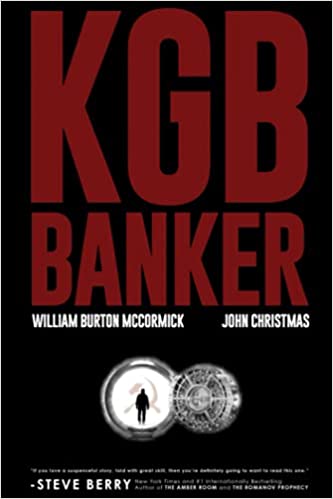
Most Libertarian Futurist Society members enjoy reading fiction, but few write it. John Christmas, a veteran LFS member and Best Novel finalist judge based in Europe, does both.
A former banker whose banking career ended when his whistleblowing against his employer was covered up by the European Bank for Reconstruction and Development, Christmas wove his real-life experiences into his novel KGB Banker, co-written with William Burton McCormick.
The novel has just been recognized by Best Thrillers as the “Best Conspiracy Thriller of 2022.”
The alien Tralfamadorians surely won’t be the only sentient beings celebrating the 100th anniversary Nov. 11, 2022, of Kurt Vonnegut’s birth.
Kurt Vonnegut in 1972 (Creative Commons license)
Anyone who appreciates a blend of humor with social commentary in novels and stories that often incorporate science fiction should celebrate the memory of one of the most influential and popular American writers and novelists of the 20th century.
1995 was a pretty good year for Anderson, at least as far as the Prometheus Award is concerned. Anderson also won the Prometheus Award that year for his novel The Stars Are Also Fire.
SF author Wil McCarthy, the 2022 Prometheus Best Novel winner for Rich Man’s Sky, took a long hiatus from writing science fiction, but now he’s back – and happy to answer a few questions about his work.
In the first part of this two-part interview, McCarthy explains why he went on hiatus, admires Robert Heinlein and reads the leading libertarian magazine Reason every day.
SF writer Wil McCarthy Photo courtesy of author
Q: You’ve written quite a few sf novels and stories. Why did you go on hiatus and what have you written since you returned?
A: I took a long hiatus from writing to run a tech start-up, among other things. When I came back, the first thing I did was write two novellas, the second of which ended up winning the AnLab award.
Then I wrote two novels, the second of which is Rich Man’s Sky, so it’s nice to see people actually taking notice. It’s a nice way to ease back in.

 …. again.