Brave New World: Huxley’s 1932 dystopian classic ranks among the oldest works to win the Prometheus Hall of Fame award


By Michael Grossberg

Aldous Huxley’s Brave New World is one of the oldest works to win the  Prometheus Award for Best Classic Fiction.

Published in 1932 by Chatto & Windus, Aldous Huxley’s pioneering dystopian novel has become so well-known around the world that its title has become an emblematic catchphrase signaling the dangers of authoritarianism.

Brave New World is the third-oldest work and the second-oldest novel to be inducted into the Prometheus Hall of Fame. (The roughly hourlong Zoom ceremony, open to the public, is scheduled to begin at 1 p.m. Sunday Aug. 16 (Eastern time), with the Zoom link posted a week or so ahead on the Prometheus Blog.)

Continue reading Brave New World: Huxley’s 1932 dystopian classic ranks among the oldest works to win the Prometheus Hall of Fame award


J. Kenton Pierce’s A Kiss for Damocles: First-time nominee wins Prometheus Award for debut novel over stiff competition


By Michael Grossberg

A first-time Prometheus nominee might not be expected to win the Best Novel award, especially with a debut novel or when up against solid works by several popular and acclaimed previous winners.

J. Kenton Pierce (Courtesy of Raconteur Press)

Yet, that’s part of the impressive accomplishment this year of J. Kenton Pierce, whose debut novel A Kiss for Damocles has won the 2026 Prometheus Award for Best Novel.

The science fiction novel, published by Raconteur Press and launching Pierce’s Tales From the Long Night series, illuminates the ethics and efficacy of free trade and self-defense as a proper foundation for civilization.

This year’s award, focusing on novels published in 2025, was considered by many Libertarian Futurist Society members and Prometheus Best Novel judges to have one of the strongest lineups in many years.

Continue reading J. Kenton Pierce’s A Kiss for Damocles: First-time nominee wins Prometheus Award for debut novel over stiff competition


The rewards of patience: The Prometheus Hall of Fame’s track record of recognition and frequent renominations

By Michael Grossberg

Patience can be a virtue – especially when it comes to nominations for the Prometheus Hall of Fame.

Not all works that become Hall of Fame finalists or winners do so in the first year that they are nominated. But that’s never a permanent obstacle to recognition, because in this annual Prometheus category, Libertarian Futurist Society members benefit from the luxury of time.

If at first a work is overlooked or doesn’t rank high enough to become a finalist, it can be nominated and renominated in future years.

Continue reading The rewards of patience: The Prometheus Hall of Fame’s track record of recognition and frequent renominations

The biggest novels in Prometheus history: An annotated list of the top dozen in page length (and why such epic works reward readers)


By Michael Grossberg

Size matters – or at least it can make a big difference, in helping a novel to achieve greater dramatic impact in its scope, depth, narrative complexity and emotional power.

Quite a few longer novels have been recognized by the Prometheus Awards over the past 47 years, whether as nominees, finalists or winners – from J.R.R. Tolkien’s The Lord of the Rings, Neal Stephenson’s Cryptonomicon and Ayn Rand’s Atlas Shrugged to the recent nomination of Sarah Hoyt’s three-volume No Mans Land for the next Prometheus Award for Best Novel.

The three classic and epic works by Tolkien, Stephenson and Rand rank No. 1, 2 and 3 in page length in the history of the Prometheus Awards – as detailed in previous Prometheus Blog articles about the three bestselling winners and No Man’s Land.

So what are all the Prometheus-recognized novels and their ranks in page lengths on our top-12 list?

Continue reading The biggest novels in Prometheus history: An annotated list of the top dozen in page length (and why such epic works reward readers)


The epic power and enduring appeal of the biggest Prometheus-honored novels: The Lord of the Rings, Cryptonomicon and Atlas Shrugged


By Michael Grossberg

Of the many novels that have won a Prometheus Award over the past 47 years and are still widely read today, a notable few have done so with the help of their longer length and epic scale.

From J.R.R. Tolkien’s The Lord of the Rings to Neal Stephenson’s Cryptonomicon and Ayn Rand’s Atlas Shrugged, size does matter in literature.

Or at least size can significantly enhance a novel, if the writers are experts and at the top of their game. If well-structured, well-paced and compelling enough to sustain the reader’s interest, longer novels can attract and retain the reader’s interest even through hundreds of pages.

Continue reading The epic power and enduring appeal of the biggest Prometheus-honored novels: The Lord of the Rings, Cryptonomicon and Atlas Shrugged


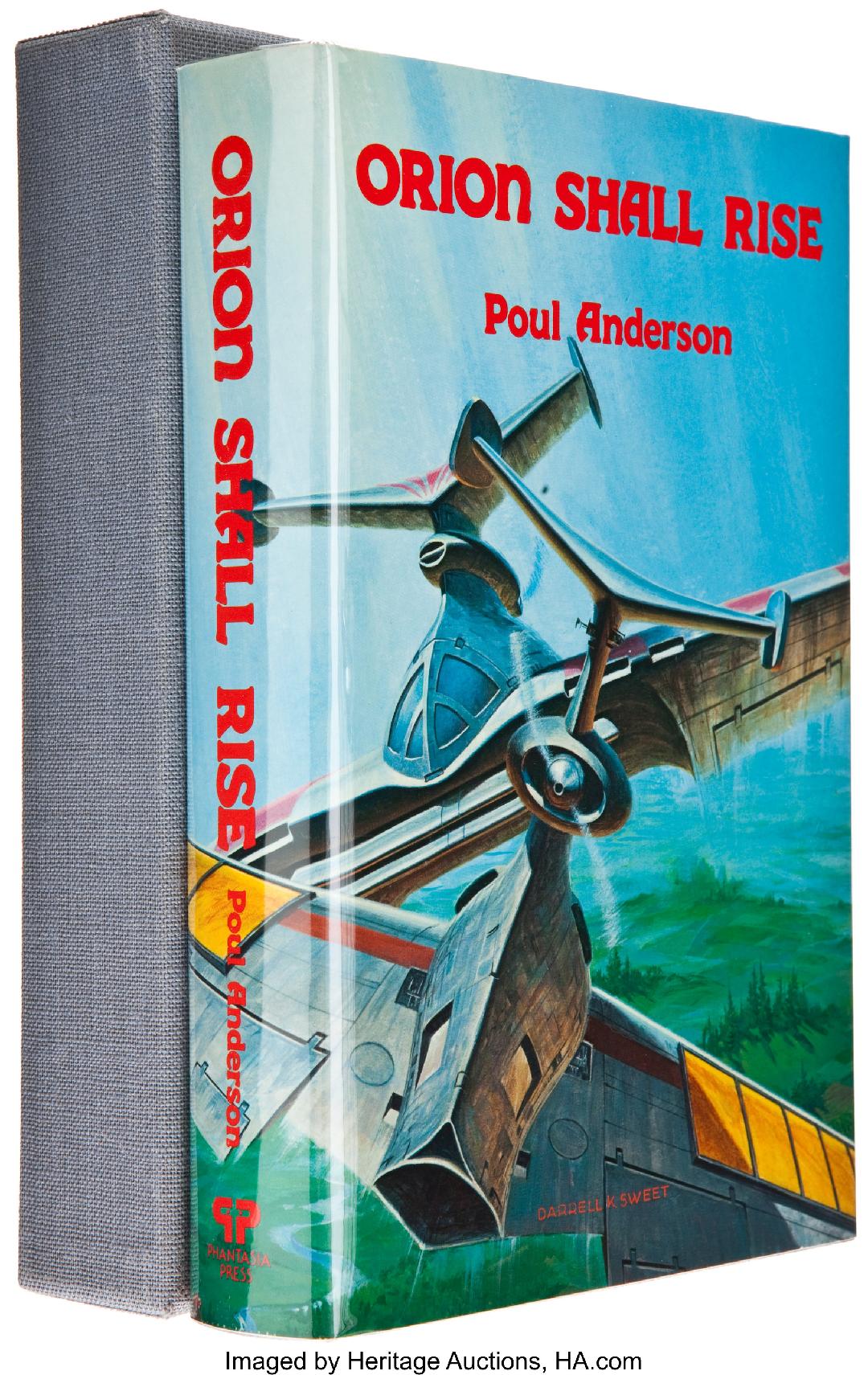
Power myths, clashing cultures and the necessity of freedom: The first Prometheus review of Poul Anderson’s “brilliant” Orion Shall Rise


By Michael Grossberg

With Poul Anderson’s Orion Shall Rise inducted most recently into the Prometheus Hall of Fame for Best Classic Fiction, it’s interesting to look back on our initial review of the 1983 novel for its insights and first impressions.

Victoria Varga, the first LFS Director and editor of the print edition of Prometheus from 1983 to 1988, reviewed Anderson’s science fiction novel when it was first nominated for a Prometheus Award for Best Novel.

Thanks in part to her positive review, Orion Shall Rise was selected by Libertarian Futurist Society members as a 1984 Best Novel finalist (the year that J. Neil Schulman’s The Rainbow Cadenza won our award.)

Most notably, Varga praised Anderson for doing “a brilliant job of creating mythologies, religious and secular, for his characters and their civilizations.”

Continue reading Power myths, clashing cultures and the necessity of freedom: The first Prometheus review of Poul Anderson’s “brilliant” Orion Shall Rise


Sequels, part 11: Unlike literary sequels, movie sequels and genre films don’t get as much respect at the Oscars, but that may be changing


By Michael Grossberg

Movie sequels seem to be more common and more popular than ever in the 21st century, often dominating at the box office. Yet, they just don’t get as much respect or awards recognition as literary sequels.

Far fewer sequels have won Academy Awards than have been recognized by science fiction and fantasy’s Hugo and Prometheus awards.

Just consider how few movie sequels have won the Oscar for Best Picture compared to how often sequel novels win a top SF/fantasy award.

Within the 46-year history of the Prometheus Awards, 194 of the 505 novels nominated within the Best Novel category have been sequels – and 11 have gone on to win.

Meanwhile, as recently reported here, nine sequel novels have won the Best Novel category in the 72-year history of the Hugo Awards, voted by members of the World Science Fiction Society and presented annually at the Worldcon.

Yet, in the 97 years that the Academy Awards have been presented, only two movie sequels have won Best Picture: The Godfather Part II and The Lord of the Rings: The Return of the King.

Intriguingly, both movies were key parts of the only trilogies or series to have three films nominated for Best Picture, perhaps partly reflecting the stature and impact of the overall effort.

And perhaps coincidentally, both movies dramatize libertarian and classical-liberal themes about the temptations and abuses of power.

Continue reading Sequels, part 11: Unlike literary sequels, movie sequels and genre films don’t get as much respect at the Oscars, but that may be changing


Sequels, part 10: Like the Prometheus Awards, the Hugo awards often recognize sequels – including many of the same novels and authors

By Michael Grossberg

Within the 46-year history of the Prometheus Awards, 194 of the 505 novels nominated within the Best Novel category have been sequels, as previously reported – and 11 have gone on to win. Yet, the Prometheus Awards are not the only science fiction awards that often recognize sequels.

Quite a few have been honored by the Hugo Awards, voted by members of the World Science Fiction Society and presented annually at Worldcons.

By my count, the Hugos have honored sequels nine times in the Best Novel category. Interestingly, quite a few of those authors also have been recognized in the Prometheus Awards – including Lois McMaster Bujold, Orson Scott Card, C.J. Cherryh and Vernor Vinge. In several cases, both awards have recognized writers for the same works.

This overview of such recognition reminds us of the frequent overlap between the Hugos and the Prometheus awards while shedding light on the popularity and appeal of sequels.

Continue reading Sequels, part 10: Like the Prometheus Awards, the Hugo awards often recognize sequels – including many of the same novels and authors

Prometheus Hall of Fame nominees for Best Classic Fiction include novels by Blish, Dick, Huxley, Lewis, Roberts, Stross and Turtledove, a Pohl short story and Straczynski’s Babylon 5


By Michael Grossberg

James Blish in the 1950s (Creative Commons license)

Works by James Blish, Philip K. Dick, Aldous Huxley, C.S. Lewis, Frederik Pohl, Adam Roberts, J. Michael Straczynski, Charles Stross and Harry Turtledove have been nominated for the next Prometheus Hall of Fame Award for Best Classic Fiction.

Aldous Huxley (Creative Commons license)

A majority of this year’s Hall of Fame nominees are appearing on the short list for the first time – a promising sign that this category for time-honored classic fiction remains full of notable and lasting works worth recognizing.

C.S. Lewis (Creative Commons license)

The oldest nominee on the list is Aldous Huxley’s 1932 novel Brave New World, with the second-oldest C.S. Lewis’ 1945 novel That Hideous Strength.

While Lewis’ cautionary sf novel has been nominated before and previously has ranked as a Best Classic Fiction finalist, Huxley’s dystopian classic has never before been nominated for the Prometheus Award – and is arguably overdue.

Continue reading Prometheus Hall of Fame nominees for Best Classic Fiction include novels by Blish, Dick, Huxley, Lewis, Roberts, Stross and Turtledove, a Pohl short story and Straczynski’s Babylon 5


The Locus rave review of Michael Flynn’s last novel – with a remarkable apology – may signal a broader re-evaluation of the three-time Prometheus winner


By Michael Grossberg

Winning literary awards and receiving rave reviews can boost the careers of novelists, by raising their visibility and enhancing their reputation. That’s sadly no longer fully possible for the late great Michael Flynn.

Michael Flynn, a three-time Prometheus Best Novel winner (Creative Commons license)

Flynn, who died in 2023 at 75, recently was announced in an LFS press release as the 2025 winner of the Prometheus Award for Best Novel for In the Belly of the Whale.

His epic social novel, a sobering drama about challenges and conflicts among the crew on a vast colony ship two centuries into a projected eight-century voyage to settle Tau Ceti, was the last novel Flynn wrote before his death. 

Published in 2024 by CAEZIK SF & Fantasy, Flynn’s novel has garnered some attention – especially an extraordinary review in Locus magazine (excerpted below) that amounts to a mea culpa for previously overlooking and underestimating Flynn.

Yet, both during his five-decade writing career and after his passing, Flynn has not garnered as much attention and appreciation from other critics and mainstream publications as I think the author and his last book deserve.

Shahid Mahmud, CAEZIK founder-publisher and a huge enthusiast for Flynn’s fiction, agrees. Mahmud tells me that he considers Flynn one of the most underestimated science fiction writers of his generation.

Continue reading The Locus rave review of Michael Flynn’s last novel – with a remarkable apology – may signal a broader re-evaluation of the three-time Prometheus winner