Patience can be a virtue – especially when it comes to nominations for the Prometheus Hall of Fame.
Not all works that become Hall of Fame finalists or winners do so in the first year that they are nominated. But that’s never a permanent obstacle to recognition, because in this annual Prometheus category, Libertarian Futurist Society members benefit from the luxury of time.
If at first a work is overlooked or doesn’t rank high enough to become a finalist, it can be nominated and renominated in future years.
Throughout the 46-year history of the Prometheus Award, 505 novels have been nominated for Best Novel.
That’s a surprisingly large number, at least to me – and a cumulative total that I don’t believe has been calculated and reported before, or at least not in many years.
Yet, when I counted them up recently, I was even more surprised by the number of Best Novel nominees that turn out to be sequels. (Quite a few were hard to identify as sequels, by the way, until I researched each title – with some so obscure, and not immediately recognizable as sequels when nominated and read by Prometheus judges and LFS members, because many work fine as stand-alone stories without any obvious indications of previous works.)
Can you guess how many Best Novel nominees have been sequels?
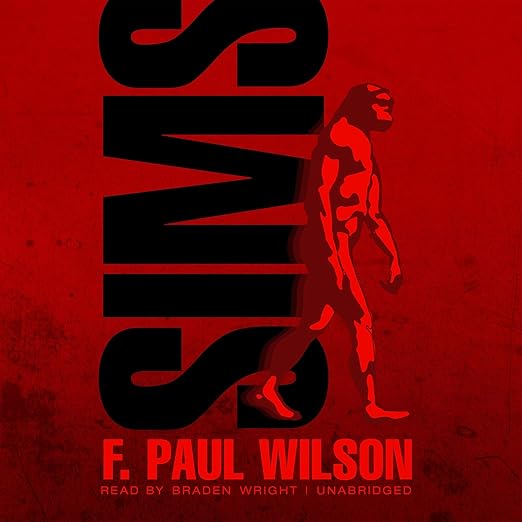
Sims, the 2004 Prometheus winner for Best Novel, is on sale.
The novel, by five-time Prometheus winner F. Paul Wilson, is available as an ebook for 90 percent off at both Amazon (for $1.99) and Bookbub (for $2).
One of Wilson’s most libertarian science fiction novels, Sims offers a cautionary tale about genetic engineering and the struggle of the sims, a genetically engineered cross between humans and champinees, for freedom and respect.
His central question: Should genetically enhanced creatures be viewed as animals, to be owned, or as human, with basic rights?
Wilson explores such basic libertarian issues with gripping drama in this plausible, suspenseful and well-paced scientific thriller.
Quite a few outstanding SF/fantasy novels have inspired sequels that have won a Prometheus Award – 11, by my latest count, and more than I’d remembered or imagined.
Vernor Vinge at an SF con (File photo)
In a few especially notable cases, writers have conceived Prometheus-winning novels inspired by previous successes and subsequently inspiring worthy sequels – several of which went on to receive further Prometheus recognition at different levels.
F. Paul Wilson (Creative Commons license)
This blog post will discuss such sequel novels by two of our most widely praised and bestselling authors: Vernor Vinge and F. Paul Wilson.
Perhaps it’s no coincidence, then, that both writers have won multiple Prometheus Awards – including for several entertaining, thought-provoking and mind-expanding works set within the same future history.
One of the most exciting and promising Libertarian Futurist Society outreach projects in years is our new Prometheus Awards Collection for Libraries.
The ambitious project offers a carefully curated selection of Prometheus-winning novels to be donated and mailed to interested libraries across the country upon their request.
The set of brand-new books was chosen to expand the range and variety of notable and acclaimed science fiction on library shelves across the country – especially to aid smaller libraries, which may have more limited resources.
What do Poul Anderson, Ray Bradbury, Robert Heinlein, James P. Hogan, Sarah Hoyt, Victor Koman, Ursula K. Le Guin, Ken MacLeod, George Orwell, Ayn Rand, L. Neil Smith, Neal Stephenson, J.R.R. Tolkien, Vernor Vinge and F. Paul Wilson have in common?
Robert Heinlein in the 1980s (Photo courtesy of Heinlein Trust)
Some rank high among bestselling and even world famous authors; some are not quite as well known but still have sold millions of copies of their books, and a few are lesser-known writers who deserve a wider readership.
George Orwell. (Creative Commons license)
Yet they’re all writers who have written notable speculative fiction (generally science fiction and/or fantasy) that in different ways championed freedom-loving themes and exposed the evils of authoritarianism.
And all of the above have been recognized for such works by winning Prometheus Awards – some for Best Novel, some for Best Classic Fiction and several for both annual award categories.
Who are the most popular authors in Prometheus Awards history?
Prometheus, the light bringer (Creative Commons license)
One could answer that question in several different ways, such as looking at a bestselling writer’s number of books sold or in print – or more narrowly, in terms of our award, comparing the number of Prometheus Awards different writers have won over the decades in different categories. (The Prometheus Blog will explore the latter perspective in later postings.)
But let’s focus first on one parameter that roughly reflects the ongoing popularity and relevance of different sf/fantasy authors among LFS members over more than four decades: How many times an author has simply been nominated by LFS members for a Prometheus Award.
Without peeking at the next page or examining the track record of past winners on the LFS website’s Prometheus Awards page, how many of the Top Ten most popular authors can you guess?
By now, more than four decades after the Prometheus Awards were first presented, many authors have won the annual award for Best Novel – but just 10 writers have won more than one.
One of the things I do in my spare time is bring old issues of Prometheus onto the web. Prometheus, the LFS’ former print quarterly, was published from 1982 to 2015, and there are lots of articles of lasting value in this collection. Well more than half the issues are now available on the web.
One thing I noticed a little while ago is that we have transcripts of many of the Prometheus Award acceptance speeches that have been given over the years, and they are worth reading again. We also have recordings of several of the ceremonies, but uploading those will be a separate project.
Here’s a quick guide to all the speeches that appeared in Prometheus:
Everyone has their favorites among the fiction works that have won the Prometheus Hall of Fame for Best Classic Fiction.
And by everyone, I mean virtually everyone – since at least some of the 46 winning works are enjoyed by libertarians and non-libertarians alike, and by both science fiction/fantasy fans and those who don’t often read that genre.