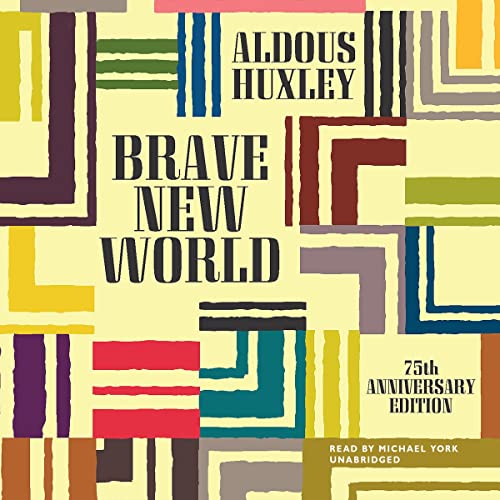
Aldous Huxley’s Brave New World is one of the oldest works to win thePrometheus Award for Best Classic Fiction.
Published in 1932 by Chatto & Windus, Aldous Huxley’s pioneering dystopian novel has become so well-known around the world that its title has become an emblematic catchphrase signaling the dangers of authoritarianism.
Brave New World is the third-oldest work and the second-oldest novel ever inducted into the Prometheus Hall of Fame.
Brave New World will be inducted this year into the Prometheus Hall of Fame for Best Classic Fiction, based on a vote by LFS members.
With its induction Sunday Aug. 16 during the 46th Prometheus awards ceremony, Aldous Huxley’s classic dystopian novel will be the 50th work to win this annual awards category, first presented in 1983.
Brave New World, ranked in fifth place by Modern Library on its list of the 100 Best Novels in English of the 20th century, continues to be considered among the most influential works of dystopian literature.
By Michael Grossberg A first-time Prometheus nominee might not be expected to win the Best Novel award, especially with a debut novel or when up against solid works by several popular and acclaimed previous winners.
J. Kenton Pierce (Courtesy of Raconteur Press)
Yet, that’s part of the impressive accomplishment this year of J. Kenton Pierce, whose debut novel A Kiss for Damocles has won the 2026 Prometheus Award for Best Novel.
The science fiction novel, published by Raconteur Press and launching Pierce’s Tales From the Long Night series, illuminates the ethics and efficacy of free trade and self-defense as a proper foundation for civilization.
This year’s award, focusing on novels published in 2025, was considered by many Libertarian Futurist Society members and Prometheus Best Novel judges to have one of the strongest lineups in many years.
Patience can be a virtue – especially when it comes to nominations for the Prometheus Hall of Fame.
Not all works that become Hall of Fame finalists or winners do so in the first year that they are nominated. But that’s never a permanent obstacle to recognition, because in this annual Prometheus category, Libertarian Futurist Society members benefit from the luxury of time.
If at first a work is overlooked or doesn’t rank high enough to become a finalist, it can be nominated and renominated in future years.
Acclaimed science fiction writer David Brin will receive the National Space Society’s Arthur C. Clarke Memorial Award.
Novelist David Brin (ISDC, Creative Commons license)
Brin, a Prometheus Best Novel finalist and two-time Prometheus nominee, expressed his libertarian/liberal views about how the world should be and is evolving toward greater freedom in “Confessions of a Cheerful Libertarian,” published in the former Prometheus quarterly.
According to a report in File 770, Brin will receive the coveted Clarke Memorial Award for “his pivotal writing in sci-fi and futurism.”
Locus magazine has released its Locus Awards finalists for the past year’s best science fiction and fantasy – always a good list to consider for SF/fantasy fans, including LFS members.
There are some excellent novels on the Locus shortlists, based on my own wide readings this past year as a Prometheus Awards Best Novel judge – and as a lifelong SF/fantasy fan.
It’s also an interesting list to compare to the Prometheus Awards, not only in terms of potential overlaps with same-year nominees but also what novels and novelists both awards have recognized.
War by Other Means, a Prometheus Best Novel finalist, is the seventh volume in Karl K. Gallagher’s future history series Fall of the Censor. After several volumes focused on military conflict, War by Other Means changes its focus to diplomatic relations among the worlds fighting against the Censorate.
In doing so, it brings Wynny Landry, the wife of Marcus Landry, the protagonist of several previous books, as a new protagonist, in the role of the ambassador from her native planet, Corwynt.
The 2026 Prometheus Best Novel finalists have been announced – and Libertarian Futurist Society members are reading them, with the ultimate verdict and winners to be selected by July 4 on the final ballot.
To spark thought and discussion, raise the visibility of these works and the award and hopefully serve as a helpful guide, the Prometheus Blog is publishing thoughtful, in-depth reviews by Prometheus judges of each finalist. Some LFS members may wish to read them right away; others may prefer to wait until they’ve finished a finalist before reading the review.
Meanwhile, to whet your appetite to read each finalist and vote in the final stage of the Prometheus Awards, here are roughly equal 200-word capsule descriptions of each finalist.
And we’ve striven to avoid revealing any spoilers, so it’s safe to read them now!
Three former Prometheus winners, a frequent Best Novel finalist and a first-time nominee are competing to win this year’s Prometheus Award for Best Novel.
J. Kenton Pierce (Photo courtesy of Raconteur Press)
The Prometheus Best Novel Judging Committee, drawn from the LFS membership, has selected five 2025 novels as 2026 finalists from 14 nominated works. The Best Novel finalists, listed in alphabetical order by author, are Storm-Dragon, by Dave Freer (Raconteur Press); War by Other Means, by Karl K. Gallagher (Kelt Haven Press); No Man’s Land, by Sarah Hoyt (Goldport Press); A Kiss for Damocles, by J. Kenton Pierce (Raconteur Press); and Powerless, by Harry Turtledove (CAEZIK SF & Fantasy.)
Pierce was nominated for the first time for a Prometheus Award, so his inclusion as a Best Novel finalist is particularly impressive in a year that many judges feel has been a superior one for freedom-themed SF/fantasy.