
One of the most chilling and distasteful aspects of the totalitarian dictatorship that George Orwell envisioned in Nineteen Eighty-Four was the “two-minute hate.”
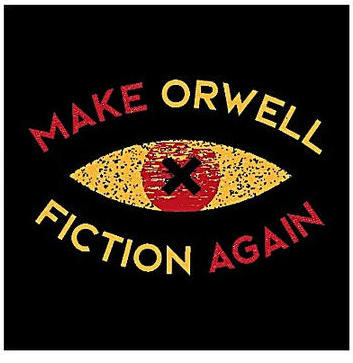 Fuelled by State propaganda demonizing dissidents and alleged enemies, and reflecting the mob psychology of true believers manipulated by power-hungry rulers, the “two-minute hate” is the type of Reign of Terror phenomenon that no sane and decent person would wish to be part of – or be victimized by – in real life.
Yet, increasingly in American and European politics and culture, extreme partisans of Left and Right indulge in hateful rhetoric while ironically accusing others of “hate” – even when a bit of introspection and understanding of human behavior might reveal fewer people than one might think are actually motivated by that dark emotion.
Referencing Orwell and his Prometheus Hall of Fame-winning classic Nineteen Eighty-Four, libertarian economist David Henderson identifies the disturbing trend of using and abusing language to demonize anyone who holds differing views.
“What Is a Hater?,” Henderson asks on his Substack column, I Blog to Differ.

“When I grew up, we used the word “hater” to describe someone who hates. Seems obvious, right? But now the meaning has evolved. At first, it seemed to mean someone who was angry at someone. I’m often angry at people; I rarely hate those same people,” Henderson writes.
“Now it seems to have evolved further to mean someone who is critical of someone or even critical of just the person’s ideas or actions. I saw an instance of this in an X by Utah Senator Mike Lee recently. He wrote: ‘What will Trump’s haters do if his tariff play brings country after country to the negotiating table, resulting in bilateral trade agreements that make U.S. trade more free than ever?’
“Maybe Lee was referring to Trump’s actual haters, of whom there are millions. Who knows what they would do? They would probably keep hating.
“Somehow, though, I have the uncomfortable feeling that Senator Lee would include me among the haters, simply because I’m strongly critical of Trump’s unilateral imposition of tariffs,” Henderson writes.
Always balanced and reasonable in his must-read Substack blog, Henderson rightly observes that such misuse of language is bipartisan – and offers examples.
“Language matters. The late Thomas Szasz stated, “In the animal kingdom, the rule is, eat or be eaten; in the human kingdom, define or be defined.”

“Whoever does the defining, it’s important to get the definitions right,” Henderson says.
“George Orwell pointed out that language affects thinking. If you keep calling a critic a “hater,” at some point you may think, without any justification, that he hates you.”
Bio note: David Henderson, who I first became acquainted with at a libertarian convention in San Francisco in the late 1970s, is a retired Canadian-born American economist and author.
A research fellow at Stanford University’s Hoover Institution since 1990, Henderson is an emeritus economics professor and served as a senior economist with the president’s Council of Economic Advisers in the early 1980s.

He has written articles for The New York Times, The Wall Street Journal, Barron’s, Fortune, and The Freeman and has appeared on CNN, MSNBC, Fox, the BBC and C-SPAN.

Among his books: The Joy of Freedom: An Economist’s Odyssey, his highly recommended autobiography; Making Great Decisions in Business and Life; and (as editor) The Fortune Encyclopedia of Economics and The Concise Encyclopedia of Economics.
ABOUT THE PROMETHEUS AWARDS AND THE LFS:
* Join us! To help sustain the Prometheus Awards and support a cultural and literary strategy to appreciate and honor freedom-loving fiction, join the Libertarian Futurist Society, a non-profit all-volunteer association of freedom-loving sf/fantasy fans.
Libertarian futurists understand that culture matters. We believe that literature and the arts can be vital in envisioning a freer and better future.
In some ways, culture can be even more influential and powerful than politics in the long run, by imagining better visions of the future incorporating peace, prosperity, progress, tolerance, justice, positive social change, and mutual respect for each other’s rights, human dignity, individuality and peaceful choices.

* Prometheus winners: For the full list of Prometheus winners, finalists and nominees – including the annual Best Novel and Best Classic Fiction (Hall of Fame) categories and occasional Special Awards – visit the enhanced Prometheus Awards page on the LFS website, which now includes convenient links to all published essay-reviews in our Appreciation series explaining why each of more than 100 past winners since 1979 fits the awards’ distinctive dual focus on both quality and liberty.
* Watch videos of past Prometheus Awards ceremonies, Libertarian Futurist Society panel discussions with noted sf authors and leading libertarian writers, and other LFS programs on the Prometheus Blog’s Video page.
* Read “The Libertarian History of Science Fiction,” an essay in the international magazine Quillette that favorably highlights the Prometheus Awards, the Libertarian Futurist Society and the significant element of libertarian sf/fantasy in the evolution of the modern genre.
* Check out the Libertarian Futurist Society’s Facebook page for comments, updates and links to Prometheus Blog posts.

The same point might be made about the label “racist” and about a whole list of words ending in “-phobe.”