
When it comes to film versions of George Orwell’s Animal Farm, the third time’s not the charm.

With visionary director-actor Andy Serkis at the helm of the recently released animated film version of Orwell’s classic anti-authoritarian fable and a host of great actors doing the voices of the farm animals, I’d hoped for the best for Animal Farm, inducted in 2011 into the Prometheus Hall of Fame.
Seth Rogen, Gaten Matarazzo, Glenn Close, Woody Harrelson, Kieran Culkin, Steve Buscemi, Kathleen Turner, Laverne Cox and Jim Parsons are among the actors voicing the animal characters in the story about pigs consolidating control on a farm in a movement for equality that is systematically corrupted.
Yet, Serkis’ long-in-gestation 2025 film, finally released in the U.S. in May 2026, has proved to be a major disappointment.
AT LEAST IT HAS A GOOD CAST
The only bright spot, relatively speaking, has been praise for the performers.
Rogen voices Napoleon, the boar who co-leads the rebellion and rise to power at Animal Farm. Matarazzo voices the piglet Lucky; Culkin, the pig Squealer; Cox, the sow Snowball; Turner, the donkey Benjamin; Harrelson, the horse Boxer; and Parsons as the sheep Carl and Carl’s flock.

Serkis himself voices Randolf the rooster and Farmer Jones (uncredited), the original owner of the farm.
A SANITIZED AND ILLOGICAL STORY
Aside from the compelling voices, the reviews have been overwhelmingly negative, describing the film as sanitizing Orwell’s dark satire about communism into a “cutesy” family-friendly but often illogical comedy.
In addition, critics have singled out the CGI animation as “ugly,” “cheap” and “dead-eyed” with “stiff movement.”
A PERVERSION OF ORWELL’S ANTI-AUTHORITARIAN THEMES
Worse, the film moves away from political commentary toward childish humor and a “bastardized” plot that imposes trendy current progressive notions on a story that was clearly inspired by the evils of communism and radical egalitarianism.
Instead of critiquing the consequences of communism and statism in claiming a false equality but actually imposing a new tyranny, Serkis’ film now makes capitalism and wealthy entrepreneurs the bad guys. Glenn Close plays a billionaire neighbor who schemes to take over the farm.
Thus, contrary to Orwell’s original intention, the new animated Animal Farm has been refocused to pander to simplistic progressive-left fantasies focusing on wealth rather than power as the true locus of evil that seemingly explains nearly everything that’s wrong with the world.

A SAMPLING OF THE REVIEWS
But don’t take my word for it. Here’s a sample of excerpts quoting from representative reviews:
“In theory, there’s no reason why there can’t be a new spin on George Orwell’s “Animal Farm” that might intrigue modern audiences who don’t know or care about the Russian Revolution and the early history of the Soviet Union. But if you want to toss around references to drones, cellphones and Cybertrucks in order to deal out tired gags about shopping, tech oligarchs and Donald Trump, why bother with “Animal Farm” in the first place?,” critic Kyle Smith wrote in his Wall Street Journal review.

“As the book’s first generation of readers could not have failed to note, this barnyard fable was a grim warning about the inevitable slide from the sharing and caring of collectivism to outright tyranny as it played out in the disaster of Stalinism,” Smith wrote.
“George Orwell’s dystopian satire of aggression in the form of anthropomorphic farm animals becomes a cutsey, cardboard kiddie cartoon of staggering ineptitude and an endurance test for audiences of all ages,” former Rolling Stone and ABC News film critic Peter Travers wrote on his own The Travers Take blog.
“By refusing the purpose of allegory in Orwell’s parable — in which assorted animals of Manor Farm play out the Russian Revolution and the rise of Stalin — Angel Studios follows the infantilizing conventions made popular by Pixar and Marvel,” NR film critic Armond White wrote.
Critic Michael Ward, who gave the film 1.5 out of 5 stars, may have summed up the misconceived film’s key flaws best on his website shouldIseeit.net:
“The problems here are not that Serkis and Stoller took Animal Farm in a different direction. It’s how badly miscalculated this becomes,” Ward wrote.
“In and of itself, adapting George Orwell’s 1945 novella “Animal Farm” for a modern audience is not inherently a bad idea. We live in deeply polarized times. Orwell, more than 80 years ago, wrote a story about the rise of tyranny and, in part, how those in power use the concept of equality as a mechanism to re-establish class and societal balance. He framed it around a farm full of animals.

“A bleak, complicated work, while at times funny and satirical in tone, (Orwell’s published) Animal Farm essentially makes the argument that power is intoxicating. If someone in charge is toppled by those seeking and demanding change, it is only a matter of time before another despot or ruling class will take over. At the end of the day, someone is always standing on two legs, eager to look down on everyone else.
As the famed British historian Lord Acton once said, “absolute power corrupts absolutely.”
Andy Serkis’ attempt to repurpose and reintroduce Animal Farm as a family-friendly animated film is one of the more baffling misfires of recent memory… the film guts and reconfigures Orwell’s themes. In their place are lots of juvenile humor, random pop culture references, and painfully unfunny one-liners delivered with the enthusiasm of a high school student preparing to take an SAT test they never studied for.”
It’s good to see that film critics and journalists in the mainstream media have not forgotten Orwell’s intent and Animal Farm’s enduring themes.
OUR OWN VIEW OF ORWELL’S LITERARY CLASSIC
Such reviews are generally consistent with the Prometheus Blog’s Appreciation of Orwell’s literary classic.
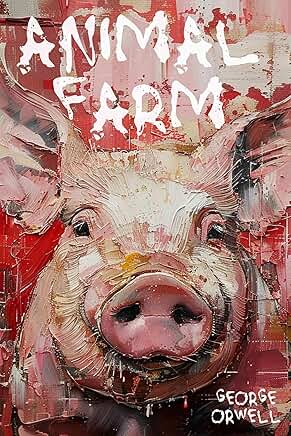
Here’s why LFS members inducted Orwell’s satirical fable into our Prometheus Hall of Fame, with key excerpts from the blog’s essay-review of the Prometheus Hall of Fame winner:
“Orwell’s story is widely considered both a classic work, and a devastating critique of Stalinism. (Napoleon, a large Berkshire boar with a reputation for getting his own way, was reportedly modeled on Joseph Stalin; while Old Major, an aged boar who provides inspiration for the initial animal rebellion, allegorically combines Karl Marx and Vladimir Lenin.)
“In retrospect, it’s easy to see that Animal Farm and its not-coincidental writing during the second World War, reflect the post-World War II disillusionment of many communists and socialists (like Orwell) with the unanticipated excesses and extremes of their ideal of collectivism. Orwell’s story is widely considered both a classic work, and a devastating critique of Stalinism. (Napoleon, a large Berkshire boar with a reputation for getting his own way, was reportedly modeled on Joseph Stalin; while Old Major, an aged boar who provides inspiration for the initial animal rebellion, allegorically combines Karl Marx and Vladimir Lenin.)
“Yet, sadly, decades after the collapse of communism around most of the planet, Animal Farm remains timely and compelling as a warning about a perennial human tendency.
“More than most works of fiction, Orwell’s cautionary animal fable clearly and simply exposes the coercive, elitist and inhuman tendencies latent in the still-widely-embraced ideals of radical egalitarianism, which pervert and invert the notion of equal liberty (which libertarians embrace) into a monstrous form of inevitably class-based tyranny that simply switches which class is on top.
“Equality and liberty, rightly understood, are not antithetical ideals, but often are in tension in society, especially when individual rights are sacrificed in the name of a false equality that masks ambitions of power.”
PREVIOUS FILM ADAPTATIONS FELL SHORT, TOO
This isn’t the first attempt to translate Animal Farm to the large or small screen – calling into question if there will ever be a film or TV version that aptly reflects the true spirit of the original.
Neither the 1954 animated film (produced with CIA involvement and notable for altering the ending) or the 1999 live-action television film (which featured characters created by Jim Henson’s Creature Shop) had much impact or was embraced by critics or the general public.
Whether in the respective years of their release or with the perspective of the passing years, neither of the two previous film efforts were acclaimed as superior adaptations that did some measure of justice to Orwell’s widely acclaimed source material.
Even compared to the two previous films, the new animated version appears to fall short – at least by the consensus of critics and its failure at the box office. (Personally, I haven’t seen it, and don’t plan to see it.)
Among all the film and TV versions of works that have won a Prometheus Award – by my rough count, 15 of more than 100 winners have been filmed, with another film (Serenity) and a TV series (The Prisoner) recognized with our awards – this new animated Animal Farm may be the worst.
Coming up soon on the Prometheus Blog: So what are all the Prometheus-winning works that have appeared as films? Which do justice to their libertarian and anti-authoritarian source material? And what other Prometheus-winning works would Prometheus Best Novel judges and other LFS members most like to see adapted for the large or small screens?
* Read the previous blog posts in this series about Prometheus winners on screen.

ABOUT THE LFS AND THE PROMETHEUS AWARDS
* Join us! To help sustain the Prometheus Awards and support a cultural and literary strategy to appreciate and honor freedom-loving fiction, join the Libertarian Futurist Society, a non-profit all-volunteer international association of freedom-loving sf/fantasy fans.
Libertarian futurists understand that culture matters. We believe that literature and the arts can be vital in envisioning a freer and better future. In some ways, culture can be even more influential and powerful than politics in the long run, by imagining better visions of the future incorporating peace, prosperity, progress, tolerance, justice, positive social change, and mutual respect for each other’s rights, human dignity, individuality and peaceful choices.
* Prometheus winners: For a full list of Prometheus winners, finalists and nominees – including in the annual Best Novel and Best Classic Fiction (Hall of Fame) categories and occasional Special Awards – visit the enhanced Prometheus Awards page on the LFS website. This page includes convenient links to all published essay-reviews in our Appreciation series explaining why each of the 106 works that have won a Prometheus since 1979 fits the awards’ distinctive dual focus on both quality and liberty.
* Watch videos of past Prometheus Awards ceremonies, Libertarian Futurist Society panel discussions with noted sf authors and leading libertarian writers, and other LFS programs on the Prometheus Blog’s Video page.
* Read “The Libertarian History of Science Fiction,” an essay in the international magazine Quillette that favorably highlights the Prometheus Awards, the Libertarian Futurist Society and the significant element of libertarian sf/fantasy in the evolution of the modern genre.
* Check out the Libertarian Futurist Society’s Facebook page for comments, updates and links to the latest Prometheus Blog posts.
