
By John C.A. Manley
The V for Vendetta graphic novel – inducted in 2006 into the Prometheus Hall of Fame – has been on my “Why haven’t I read this yet?” reading list for many years.
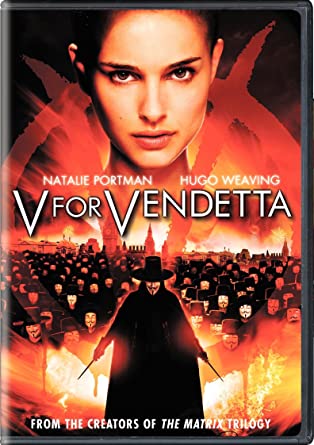
 Written by Alan Moore and illustrated by David Lloyd in 1989, its fame doubled with James McTeigue’s 2005 film adaptation, written and produced by the Wachowkis and starring Hugo Weaving.
For the last two decades, V’s smiling mask has been haunting me, asking why I have not yet read this classic of pro-liberty fiction. Well, last month, I finally read it while narrating the artwork to my blind son, Jonah (forcing me to translate every sneer, smile and shadow into words). Despite the story’s numerous flaws — which oddly enough almost enhance its philosophical flair — I feel it’s a five-star work of art.

The movie and graphic novel – each recognized with a Prometheus Award, with the novel inducted in 2006 into the Hall of Fame and the film receiving a Special Award in 2007 – are both mentioned in my novel Much Ado About Corona , in which Vince describes the story as: “…a dagger-tossing survivor of forced medical experiments… takes on an evil British government while wearing a Guy Fawkes mask, a gaucho hat and a black cape.
The hero, named V, is also a poet, philosopher and professional practitioner of verbose verbal virtuosity who loves words that begin with V. Well, maybe he’s not fond of the word villain. But today it’s the villain of the story I’d like to talk briefly about…
Adam Susan: A Comic Book villain With Depth
While the movie’s depiction of the fascist High Chancellor, Adam Sutler, feels like a caricature of a ranting, raving, anxiety-ridden Adolf Hitler, the graphic novel’s take is far more original. In its pages, Leader Adam Susan (note the name change) comes across as a man who cares deeply about his people, seeing authoritarianism as a necessary evil, rather than a power grab. I couldn’t help but empathize with his melancholy ruminations.

Here’s a glimpse into his inner thoughts:
“The only freedom left to my people is the freedom to starve, the freedom to die, the freedom to live in a world of chaos. Should I allow them that freedom? I think not. I think not. Do I reserve for myself the freedom I deny to others? I do not. I am but a servant. I, who am master of all that I see… “
“I have so very little…. I have never known the soft whisper of endearment…. But I am respected. I am feared. And that will suffice.”
Hardly a 2D comic book villain.
The graphic novel also differs from the movie in that the government is not led by the whims of a despot, but by a supercomputer named Fate — foreshadowing the AI technocracy our algorithmic nanny states are hurtling towards today.
David Lloyd’s Dystopian Backdrop

The artwork is a little like stumbling out of a summer afternoon into a candlelit cellar — slightly grim at first, but as my eyes adjust, the dystopian backdrop takes on a sweeping, majestic vibe that I find almost musical:
And, unlike the film, there is little blood, despite just as many knifefights.
Interestingly, V’s insistence on using knives to fight men with guns appears to be purely philosophical, rather than practical. As far as I can tell, there are two reasons for this unorthodox tactic:
1. The gun is the weapon of the state. The most common first move of tyrannical regimes is to outlaw gun ownership. V opposes not only the state, but also the means of their monopolized power over the people.
He’s not anti-gun, just anti-government, but he sees the two as one.
2. Another insinuated reason for his fondness for blades over bullets appears to be one of empathy. The distance at which a gun can be used makes the harm they cause less felt by the wielder. A dagger, sword or knife, on the other hand, requires a closeness with your opponent. You feel the blade enter their flesh and experience their pain. It’s not impersonal at all, which limits its use.
Of course, I doubt Alan Moore is recommending Texans turn in their shotguns for a Ginsu. Like so many aspects of the story, it’s not about realism, but symbolism. The rejection of bullets in the novel is also a rejection of ballots — no longer voting for which slave master has a monopoly on the use of force.

Ideas Are Bulletproof
Ideas are bulletproof. People aren’t.
That’s the big theme in the graphic novel, V for Vendetta, written by Alan Moore….
Continuing with part three of my multi-post review of the graphic novel, its bulletproof ideas are what I’d like to focus on today.
The depth of philosophy in the graphic novel exceeds that of the film (despite the movie adaptation’s unforgettable televised speech about how people normalize oppression). In contrast, the graphic novel does not focus so much on the evils of government as on the glories of liberty, anarchy, and spontaneous order.

For example, there is a moving scene in the novel where V is talking to a statue of Lady Justice, telling her how he used to stare at her from the streets as a child and tell his father, “Isn’t she pretty?”
“But please don’t think it was merely physical,” his older self tells her now, “I know you’re not that sort of girl. No, I loved you as a person, as an ideal. That was a long time ago. I’m afraid there’s someone else now.”
That someone else is anarchy. Not chaos. But the ability to live without rulers (who get to decide who is right and who is wrong).
V accuses Lady Justice of having an affair with power, betraying him and everybody she promised to protect. The government claims the right to dictate justice, promising safety in exchange for our freedom. The result is ultimately oppression, for even the most enormous wrongs can be justified with a law, a vote and a crisis.
Ultimately, the story is about people and communities taking responsibility for their own lives, as V says:
“Since mankind’s dawn, a handful of oppressors have accepted the responsibility over our lives that we should have accepted for ourselves. By doing so, they took our power. By doing nothing, we gave it away. We’ve seen where their way leads, through camps and wars, towards the slaughterhouse.”

John C. A. Manley is the author of All the Humans Are Sleeping, a 2025 novel nominated for the Prometheus Award for Best Novel, and Much Ado About Corona, praised by The Corbett Report as “an incredibly interesting novel… a powerful rebuke to the would-be tyrants of the biosecurity state.” Get a free sample in ebook or audiobook format at: MuchAdoAboutCorona.com

ABOUT THE LFS AND THE PROMETHEUS AWARDS
* Join us! To help sustain the Prometheus Awards and support a cultural and literary strategy to appreciate and honor freedom-loving fiction, join the Libertarian Futurist Society, a non-profit all-volunteer international association of freedom-loving sf/fantasy fans.
Libertarian futurists understand that culture matters. We believe that literature and the arts can be vital in envisioning a freer and better future. In some ways, culture can be even more influential and powerful than politics in the long run, by imagining better visions of the future incorporating peace, prosperity, progress, tolerance, justice, positive social change, and mutual respect for each other’s rights, human dignity, individuality and peaceful choices.
* Prometheus winners: For a full list of Prometheus winners, finalists and nominees – including in the annual Best Novel and Best Classic Fiction (Hall of Fame) categories and occasional Special Awards – visit the enhanced Prometheus Awards page on the LFS website. This page includes convenient links to all published essay-reviews in our Appreciation series explaining why each of the 106 works that have won a Prometheus since 1979 fits the awards’ distinctive dual focus on both quality and liberty.
* Watch videos of past Prometheus Awards ceremonies, Libertarian Futurist Society panel discussions with noted sf authors and leading libertarian writers, and other LFS programs on the Prometheus Blog’s Video page.
* Read “The Libertarian History of Science Fiction,” an essay in the international magazine Quillette that favorably highlights the Prometheus Awards, the Libertarian Futurist Society and the significant element of libertarian sf/fantasy in the evolution of the modern genre.
* Check out the Libertarian Futurist Society’s Facebook page for comments, updates and links to the latest Prometheus Blog posts.

Thanks for reprinting the review, Michael. And thanks for the kind words, RH. Having a blind son has helped me focus my time on reading novels. It’s not much fun narrating a movie to a blind person. But books are fair game.
A fantastic breakdown of an iconic series, John. Like you, I have not yet read it; and I love how you incorporate your own audio interpretation for your son into your analysis! As my own eyesight deteriorates, I appreciate more and more the little details that slip by me.
Encroaching sight challenges have forced me to take reading from an almost instinctive level to a deliberate act of willpower; I missed this year’s Prometheus reading and voting because the difficulty reading now presents. But the power of your interpretation is the nuance of line and shadow refocused inot word. Your ability – to know what you see, and to share it with others – is a gift as great as sight itself.