
George Orwell is one of only a handful of Prometheus-winning writers to remain world famous and widely read for more than one work of fiction.

Meanwhile, the Prometheus Hall of Fame classic that is perhaps best known around the world is Hans Christian Anderson’s fable “The Emperor’s New Clothes.”

Perhaps still most widely acclaimed for his dystopian novel Nineteen Eighty-Four, Orwell is also frequently referenced and quoted for his satirical parable Animal Farm. (Forget the poorly reviewed 2026 animated film version, which substitutes a trendy and misguided anti-corporate ideology for Orwell’s explicit anti-communist theme.)
Of the 50 works of fantastic fiction that have now been inducted into the Prometheus Hall of Fame for Best Classic Fiction, Orwell’s classics and Andersen’s evocative fable rank high among the most notable and enduring.
And that’s why they are frequently referenced in contemporary intellectual debates and commentary – and will continue to be relevant for generations.
 One of the areas the Prometheus Blog routinely covers are the ongoing references in major media and cultural-intellectual discourse to a variety of Prometheus winners. Such references remind us of the power of art to inspire us and shape our ideas and ideals.
Here are two more interesting and insightful examples of how contemporary thinkers and commentators reference Anderson and Orwell.
HANSON ON ANDERSEN
Classical-era historian Victor Davis Hanson used the key metaphor from Andersen’s fable in one of his syndicated Tribune columns observing a sea change in quite a few contemporary social-political ideas.
 “So, what flipped everything?,” Hanson asked, referring to significant shifts in elite and popular opinion about NATO, military recruitment, job growth, international trade, academia, immigration, gender politics and much more.
“We were living in an “emperor has no clothes” make-believe world for the last few years. The people knew establishment narratives were absurd, and our supposed experts were even more ridiculous. But few — until now — had the guts to scream “the emperor is naked” to dispel the fantasies. When they finally did, reality returned.”
A LASTING METAPHOR: THE PIGS IN ANIMAL FARM
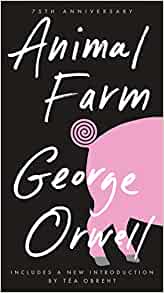
Meanwhile, an article in The Spectator magazine makes brief references to George Orwell’s satirical novel Animal Farm, inducted in 2011 into the Prometheus Hall of Fame for Best Classic Fiction.
 Gary Anderson’s article “The Case Against the Marine Corps Commandant” offers a withering critique of an authoritarian mindset and pattern of enforced intellectual conformity to preconceived and trendy dogma by the sitting president of the Marine Corps University – a troubling recent history that includes outright deception in public statements to the press.
An excerpt:
“As noted military theorist William Lind has pointed out, a particularly egregious example of the anti-intellectual bent of the Berger/Smith era: Not long ago, a German naval aviator spent some time at the Basic School, the school for all Marine lieutenants. Because the German officer had a rank above lieutenant, TBS put some lieutenants under him. He ran his small units German style, according to what maneuver warfare recommends. The Marine lieutenants loved it. The German officer was called in by other faculty who said to him, ‘You are teaching Marines to think. We don’t want them to think. We want them just to follow orders.’
“Prior to Berger/Smith, the old trope about Marines being dumb was an urban legend. The senior Marine Corps leadership actively encouraged informed professional debate among Marines at all levels. No more,” Anderson wrote.
“The current president of MCU actively encourages spying on offices to uncover thinking that he deems inappropriate.”
 What struck me about the Spectator magazine article was how brief the reference to Orwell was. Anderson never mentions either Orwell or Animal Farm. He simply refers twice to pigs.
“Some pigs are more equal than others in Smith’s Marine Corps,” Anderson writes in the middle of his article.
And then, towards the end of the article, Anderson simply repeats:
“Again, some pigs are more equal than others.”
Significantly, those two brief references were more than enough to make his meaning clear.
Orwell novel focuses on a group of pigs, led by Napoleon (inspired by Communist dictator Joseph Stalin), who take dictatorial control over other animals on a rural farm while claiming to favor equality. One quote from the story has become emblematic: “All animals are equal but some animals are more equal than others.”
 Even more than 80 years after its publication in 1945, Orwell’s parable remains so well known that virtually any reader of a leading international magazine could be reasonably expected to catch the reference.
That reflects a lasting cultural power that deserves recognition – especially when the work of fiction so eloquently affirms libertarian and anti-authoritarian themes.

ABOUT THE LFS AND THE PROMETHEUS AWARDS
* Join us! To help sustain the Prometheus Awards and support a cultural and literary strategy to appreciate and honor freedom-loving fiction, join the Libertarian Futurist Society, a non-profit all-volunteer international association of freedom-loving sf/fantasy fans.
Libertarian futurists understand that culture matters. We believe that literature and the arts can be vital in envisioning a freer and better future. In some ways, culture can be even more influential and powerful than politics in the long run, by imagining better visions of the future incorporating peace, prosperity, progress, tolerance, justice, positive social change, and mutual respect for each other’s rights, human dignity, individuality and peaceful choices.
* Prometheus winners: For a full list of Prometheus winners, finalists and nominees – including in the annual Best Novel and Best Classic Fiction (Hall of Fame) categories and occasional Special Awards – visit the enhanced Prometheus Awards page on the LFS website. This page includes convenient links to all published essay-reviews in our Appreciation series explaining why each of the 106 works that have won a Prometheus since 1979 fits the awards’ distinctive dual focus on both quality and liberty.
* Watch videos of past Prometheus Awards ceremonies, Libertarian Futurist Society panel discussions with noted sf authors and leading libertarian writers, and other LFS programs on the Prometheus Blog’s Video page.
* Read “The Libertarian History of Science Fiction,” an essay in the international magazine Quillette that favorably highlights the Prometheus Awards, the Libertarian Futurist Society and the significant element of libertarian sf/fantasy in the evolution of the modern genre.
* Check out the Libertarian Futurist Society’s Facebook page for comments, updates and links to the latest Prometheus Blog posts.
