
Amazingly prolific, C.J. Cherryh has written more than 80 novels and several short-story collections since her first fiction was published in 1976. But there will be no more. Alas, Cherryh, widely acclaimed as one of the best SF/fantasy writers of the past half century, has retired.

Sadly, her many fans – including Libertarian Futurist Society members – must accept the fact that she will write no more. But what a legacy the Hugo- and Prometheus-winning writer leaves us!
“Over the years, she has created a vast, complex universe of stories that encompass whole space-faring civilizations, interstellar wars, political upheavals, and personal challenges,” Barbara Krasnoff wrote in a heartfelt appreciation of Cherryh published by Reactor magazine.
“Cherryh’s talent for worldbuilding—or, rather, universe-building—is incredible. And once each universe is built, she has the ability to expand on it in any number of directions.”
“At the same time, she has peopled those novels with humans and a plethora of believable non-humans—hani, kif, mri, atevi, and others—all of which have fascinating and complex cultures. In other words, she manages to combine the action of space opera with a keen awareness that the ships and space stations and planets are inhabited by individuals, all with their own thoughts, dreams, and fallibilities,” Krasnoff wrote.
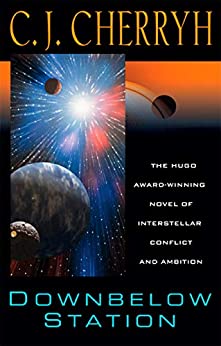 A Hugo awardwinner for Downbelow Station and Cyteen, part of her engrossing and sophisticated Alliance-Union series, Cherryh has been nominated five times for a Prometheus Award between 1983 and 2025.
Three of her novels have become Best Novel finalists (starting with Finity’s End in 1998), with Cherry winning in 2020 for Alliance Rising, co-written with her wife Jane S. Fancher.
Their sequel Alliance Unbound became a Best Novel finalist last year.

Alliance Rising and Alliance Unbound are the first two novels in Cherryh and Fancher’s projected Hinder Stars trilogy, dramatizing the early years of interstellar merchants forging a peaceful free-trading alliance within Cherryh’s Hugo-winning much larger Alliance-Union series.

With Cherryh, 83, having announced that she can no longer write because of health issues, the culmination of their Hinder Stars trilogy appears unlikely to materialize.
“The unhappy fact is—the numerous bouts of anaesthetic I’ve had have made it pretty well impossible for me to write. I drop stitches. Not many. No problems with daily life or doing creative stuff or enjoying life in general. But the ability to control narrative is just not what it was, and it’s just not going to be there. I’ve accepted that, painful as it is. I thank all of you who’ve stood by me patiently. The body of work is what it is, and I am lastingly grateful to my publisher, Betsy Wollheim, who has given me every extension of time and resource. And of course to Jane, who is all things,” Cherryh wrote in her announcement on Facebook.

Jon Del Arroz, an ardent and knowledgeable fan of Cherryh’s work, posted on www.fandompulse.com an eloquent and insightful tribute to her after her statement.
“‘The ability to control narrative is just not what it was.’ From a writer who spent fifty years building some of the most architecturally complex fictional universes in science fiction, that single sentence carries the full weight of what she is describing and accepting, Del Arroz wrote.
As Krasnoff details in her recent tribute, Cherryh’s Alliance-Union universe was introduced in Downbelow Station, “which tells the story of a far-future space-traveling human society and the conflict between a quickly irrelevant Earth, a military force turned pirate, an expanding culture based on mind control and genetic manipulation (called Union), and a loose association of family-owned merchant ships (the Alliance).
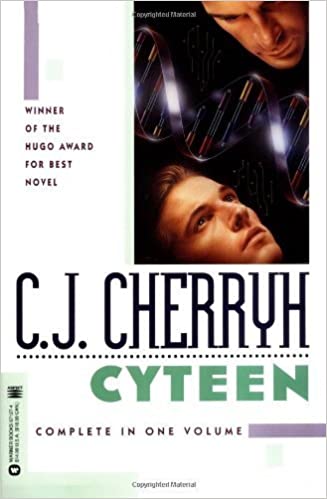 “From there, she expanded that universe to take in lost and lonely independent operators (Merchanter’s Luck), the inner workings of the Union (Cyteen), and alien societies operating outside known space (the Chanur novels).”
Another reason Krasnoff is a fan, she said, is Cherryh’s deft use of point of view.
“Most of her novels—at least, of those I’ve read—avoid the third-person omniscient point of view and put us into the heads of those who are actually part of the events,” Krasnoff wrote.
“In Downbelow Station, for example, we experience the POVs of a wide variety of players, including the hardened captain of a military vessel, the worried leader of a space station orbiting an Earth-like planet, his jealous antagonist who slowly finds out that he’s made the wrong choices, and a Downer—a member of the planet’s native species—who understands more than she is given credit for. And somehow, we are never confused about whose thoughts we are listening to, and where they are in the events being played out.”

Above all, Krasnoff is impressed with Cherryh’s overall vision and depth of intricate world-building.
“Cherryh’s ability to track all her invented worlds, cultures, and characters is absolutely mind-boggling,” she said.
While Cherryh will no longer write fiction, her immense and impressive body of work leaves her fans, and new generations of readers, with so much to explore.
FOR FURTHER READING
Check out the Prometheus Blog review of Cherryh and Fancher’s 2020 Prometheus-winning novel Alliance Rising and our review of their sequel, the 2025 Best Novel finalist Alliance Unbound.

ABOUT THE LFS AND THE PROMETHEUS AWARDS
* Join us! To help sustain the Prometheus Awards and support a cultural and literary strategy to appreciate and honor freedom-loving fiction, join the Libertarian Futurist Society, a non-profit all-volunteer international association of freedom-loving sf/fantasy fans.
Libertarian futurists understand that culture matters. We believe that literature and the arts can be vital in envisioning a freer and better future. In some ways, culture can be even more influential and powerful than politics in the long run, by imagining better visions of the future incorporating peace, prosperity, progress, tolerance, justice, positive social change, and mutual respect for each other’s rights, human dignity, individuality and peaceful choices.
* Prometheus winners: For a full list of Prometheus winners, finalists and nominees – including in the annual Best Novel and Best Classic Fiction (Hall of Fame) categories and occasional Special Awards – visit the enhanced Prometheus Awards page on the LFS website. This page includes convenient links to all published essay-reviews in our Appreciation series explaining why each of the 106 works that have won a Prometheus since 1979 fits the awards’ distinctive dual focus on both quality and liberty.
* Watch videos of past Prometheus Awards ceremonies, Libertarian Futurist Society panel discussions with noted sf authors and leading libertarian writers, and other LFS programs on the Prometheus Blog’s Video page.
* Read “The Libertarian History of Science Fiction,” an essay in the international magazine Quillette that favorably highlights the Prometheus Awards, the Libertarian Futurist Society and the significant element of libertarian sf/fantasy in the evolution of the modern genre.
* Check out the Libertarian Futurist Society’s Facebook page for comments, updates and links to the latest Prometheus Blog posts.
