Following the recently posted first part of Dave Freer’s 2023 Best Novel acceptance speech, here is the conclusion, in which the 2023 Prometheus winner describes his winning novel Cloud-Castles, how it reflects Australia’s outback culture and why he wrote it.
BY DAVE FREER
Cloud-Castles was born out of a libertarian to outright anarchist concept: that the best defense of liberty is the ability to leave any form of bondage easily.
Autocracies inevitably have barriers to keep people IN. The freer the society… the less they care if you leave. In fact, if anything, they have to try and keep themselves from being swamped by people who want in.
Dave Freer with his 2023 Prometheus Awards Best Novel plaque for Cloud-Castles (Photo courtesy of Freer)
Editor’s introduction: Dave Freer, the 2023 Prometheus winner for Best Novel for Cloud-Castles, is the first author from the Southern Hemisphere to win a Prometheus Award.
An Australian who lives in Tasmania, Freer delivers his acceptance speech from Cambridge, England, where he was visiting his son. Freer’s speech was part of the 43rd annual Prometheus Awards ceremony, which aired live Aug. 19 internationally via Zoom, with Prometheus-winning author Sarah Hoyt presenting Freer with his award. Here is the transcript of his speech:
BY DAVE FREER
Firstly, I would like to apologise for my accent. I come from a polyglot of origins, or, as rural Australians would yell it, “Yer a bloody mongrel, yer drongo.”
That’s a very accurate description, as it allows for hybrid vigour, and no pretentions of grandeur or delusions of good behaviour. I do feel rather like the scruffy mongrel who has slipped the leash, stolen a slab of bacon and a string of sausages from a butcher’s shop, and run, hotly pursued, into the midst of the hallowed halls of the Crufts dog show. There I have jumped up onto the winner’s podium, panting and grinning, to enjoy my ill-gotten gains, while the judges and former winners look on in horror.
An intercontinental friendship between two prolific science-fiction writers will add an extra measure of celebrity to the 43rd annual Prometheus Awards ceremony.
Sarah Hoyt, the 2011 Prometheus winner (File photo)
Sarah Hoyt, who won the Prometheus Award for Best Novel in 2011 for Darkship Thieves, will present the Best Novel category to Dave Freer during the live-Zoom ceremony, now scheduled for 2-2:30 p.m. Saturday Aug. 19 (Eastern U.S. time).
Australian writer Dave Freer had some interesting thoughts about the Greek God Prometheus and Robert Heinlein after learning that his novel Cloud-Castles has won the 2023 Prometheus Award for Best Novel.
“According to Aeschylus, (Prometheus) caused blind hope to live in the hearts of men (a goal of my writing if ever had one),” Freer wrote in “Prometheus Bound,” his latest post on the Mad Genius Club blog.
“A trickster who stole fire from the gods for man and pushed them towards science and technology, as well deceiving the powers-that-be (Zeus) of the day, into choosing the rubbish which looks good on the outside, instead of the good that looks rubbish on the outside… he’s my sort of guy,” Freer said.
Prolific sf author Nancy Kress has won Hugos and Nebula awards but she’s never won a Prometheus Award. Not yet, anyway.
Nor was Kress nominated for The Eleventh Gate, an interesting 2020 novel (recently reviewed in the Prometheus blog) that pits libertarian planets against more authoritarian worlds.
Nevertheless, Kress has been frequently recognized within the history of the Prometheus awards.
In fact, she has been nominated four times for Best Novel – and one of her novels (Beggars in Spain) was voted a Best Novel finalist.
Libertarian Futurist Society members have made 15 nominations for the Best Novel category of the Prometheus Award.
Of the authors nominated, two thirds are being recognized for the first time by LFS members, perhaps reflecting in part a new generation of emerging writers whose varied works fit the award’s distinctive focus on science fiction and fantasy, broadly conceived, that dramatizes libertarian and anti-authoritarian themes.
Before 2022 ends, it’s worth noting that the Prometheus Awards reached a pretty big milestone this year.
It involves a nice round number, too: 100 – the total number of works recognized by the Prometheus Awards in all three categories since the award was established more than four decades ago.
From 1979, when the very first Prometheus Award was presented to F. Paul Wilson’s novel Wheels Within Wheels, through 2022, 90 works of fiction have been recognized in the Libertarian Futurist Society’s two annual categories for Best Novel and Best Classic Fiction.
That includes 44 novels that have won a Prometheus for Best Novel, including this year’s newest winner: Rich Man’s Sky by Wil McCarthy.
And it includes 46 works – novels, novellas, stories, a graphic novel, an anthology and a TV series – that have been inducted into the Prometheus Hall of Fame for Best Classic Fiction.
Plus, 10 works have received Special Prometheus Awards – including three libertarian sf anthologies, two films, two graphic novels, a novella, a filk song and (most recently in 2017) a webcomic series.
If sci-fi fans or anyone else ever wants to know why the Libertarian Futurist Society presented a Prometheus Award to any work of fiction, and how that work reflects libertarian, classical liberal and anti-authoritarian themes, they now have an easy, quick and enjoyable way to find out.
Just visit the LFS website’s Prometheus Awards page, scroll down to any particular past winner of interest – for Best Novel, Best Classic Fiction or Special Awards – and click on the “Appreciation” link added next to its title.
To highlight and honor the four-decade history of the Prometheus Awards, which the Libertarian Futurist Society celebrated in 2019, LFS members began writing review-essays about each past winner that summer.
Sarah Hoyt has announced a new edition of her Prometheus-Award winning novel Darkship Thieves.
Released through Goldport Press after Hoyt’s reclaiming the rights from Baen Books, Darkship Thieves has now been produced in both print and ebook formats.
The Hugo awards and the Prometheus awards are different in focus, but occasionally overlap.
This year, the overlap is minimal but worth mentioning: In their respective Best Novel categories, one 2021 work has been recognized at some level by both awards.
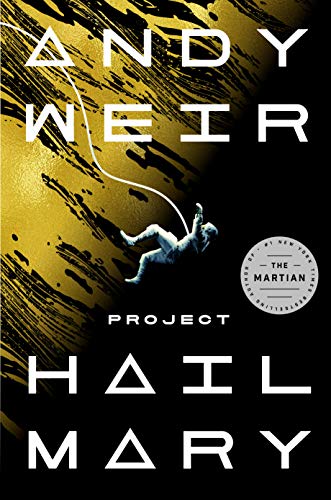
Project Hail Mary, Andy Weir’s sf novel, is one of six Best Novel finalists in the Hugo Awards, presented nearly annually since 1953 by sf fans attending or supporting the World Science Fiction convention.
Weir’s novel was also one of 16 works nominated this past year for the Best Novel category of the Prometheus Awards.