No Man’s Land: The epic novel that Prometheus winner Sarah Hoyt was born to write


By Michael Grossberg

Sarah Hoyt views No Man’s Land, nominated for the next Prometheus Award for Best Novel, as the epic story that she was born to write.

So what took her so long? The three-part novel required much of Hoyt’s life to gestate, mature and blossom – and therein lies another epic story.

“It’s been with me since I was 14,” Hoyt told me in an email interview.

Set in an interstellar future where humanity colonized many planets but also lost touch with some for centuries or millennia, the three-part 2025 novel blends tropes of science fiction and fantasy in intriguing ways.

Continue reading No Man’s Land: The epic novel that Prometheus winner Sarah Hoyt was born to write


Bradbury, Heinlein, Le Guin, Vonnegut stories ranked among the 26 best SF stories by New Scientist


By Michael Grossberg

E.M. Forster isn’t the only Prometheus-recognized author on New Scientist’s intriguing list of the 26 best science fiction/fantasy stories of all time.

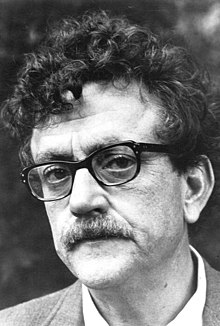
Kurt Vonnegut in 1972 (Creative Commons license)

Although Forster’s “The Machine Stop” is the only story on the list specifically inducted into the Prometheus Hall of Fame, as described in a recent Prometheus blog post, several other enduring authors have stories on the magazine’s list – just not the ones our award has recognized.

Ursula K. Le Guin (Creative Commons license)

Among those writers: Ray Bradbury, Robert Heinlein, Ursula K. Le Guin and Kurt Vonnegut.

It’s interesting to see which of their stories are recognized by the magazine, and why.

Continue reading Bradbury, Heinlein, Le Guin, Vonnegut stories ranked among the 26 best SF stories by New Scientist


The Day Before the Revolution: Ursula K. Le Guin story, a prequel to her Prometheus-winning The Dispossessed, recommended by Reactor Magazine


By Michael Grossberg

Ursula K. Le Guin’s The Day Before the Revolution has been highlighted and recommended by Reactor Magazine among “five SF stories in which hope survives.”

The story, available in the Le Guin short-story collection The Wind’s Twelve Quarters, should be of interested to LFS members and other freedom-loving SF/fantasy fans because it’s considered a sequel to Le Guin’s classic novel The Dispossessed, an early Prometheus Hall of Fame winner.

“Science fiction has the power to remind us that hope is valuable, and necessary,” James Davis Nicoll wrote in the Reactor column.

That insight, and sentiment, rings true to Prometheus Awards voters and fans. After all, our award in part aims to recognize worthy works of speculative fiction that in many cases do remind us that even amid troubled times and authoritarian societies, better and freer futures remain possible.

Continue reading The Day Before the Revolution: Ursula K. Le Guin story, a prequel to her Prometheus-winning The Dispossessed, recommended by Reactor Magazine


Ursula K. Le Guin’s Prometheus-winning The Dispossessed honored and probed on its 50th anniversary


By Michael Grossberg

Many bestsellers or award-winning books or plays or movies or record albums tend to fade over the years, but a few manage to pass the test of time.

In that latter category is Ursula K. Le Guin’s 1974 novel The Dispossessed, inducted in 1993 into the Prometheus Hall of Fame.

Recently honored on its 50th anniversary with a Harper’s 50th Anniversary Edition, Le Guin’s novel contrasts two alleged utopian worlds.

One human-settled planet is anarchist (but without property rights and with mob rule and group think); the other is mostly capitalist (but with recurrent wars and extremes of wealth and poverty.)

Continue reading Ursula K. Le Guin’s Prometheus-winning The Dispossessed honored and probed on its 50th anniversary


Forster, Bradbury, Heinlein, Le Guin, Vonnegut stories ranked among the 26 best SF stories by New Scientist


By Michael Grossberg

Several Prometheus-recognized authors are included on New Scientist’s intriguing list of the 26 best science fiction/fantasy stories of all time.

Ray Bradbury (Creative Commons license)

E.M. Forster’s “The Machine Stops” is the only story on the magazine’s list previously inducted into the Libertarian Futurist Society’s Prometheus Hall of Fame. Yet, several other enduring and Prometheus-winning authors have classic stories on the magazine’s list – just not the ones our award has recognized.

Among them: Ray Bradbury, Robert Heinlein, Ursula K. Le Guin and Kurt Vonnegut.

It’s interesting to see which of their stories are recognized by the magazine, and why.

Continue reading Forster, Bradbury, Heinlein, Le Guin, Vonnegut stories ranked among the 26 best SF stories by New Scientist


Introducing the Prometheus Awards Collection for Libraries

By Michael Grossberg

One of the most exciting and promising Libertarian Futurist Society outreach projects in years is our new Prometheus Awards Collection for Libraries.

The ambitious project offers a carefully curated selection of Prometheus-winning novels to be donated and mailed to interested libraries across the country upon their request.

The set of brand-new books was chosen to expand the range and variety of notable and acclaimed science fiction on library shelves across the country – especially to aid smaller libraries, which may have more limited resources.

Continue reading Introducing the Prometheus Awards Collection for Libraries

Heinlein, Anderson, Tolkien, Orwell, Rand, Hoyt, Vinge, Stephenson, Bradbury and Wilson among popular Prometheus-winning authors added as convenient index links on our blog

What do Poul Anderson, Ray Bradbury, Robert Heinlein, James P. Hogan, Sarah Hoyt, Victor Koman, Ursula K. Le Guin, Ken MacLeod, George Orwell, Ayn Rand, L. Neil Smith, Neal Stephenson, J.R.R. Tolkien, Vernor Vinge and F. Paul Wilson have in common?

Robert Heinlein in the 1980s (Photo courtesy of Heinlein Trust)

Some rank high among bestselling and even world famous authors; some are not quite as well known but still have sold millions of copies of their books, and a few are lesser-known writers who deserve a wider readership.

George Orwell. (Creative Commons license)

Yet they’re all writers who have written notable speculative fiction (generally science fiction and/or fantasy) that in different ways championed freedom-loving themes and exposed the evils of authoritarianism.

And all of the above have been recognized for such works by winning Prometheus Awards – some for Best Novel, some for Best Classic Fiction and several for both annual award categories.

Continue reading Heinlein, Anderson, Tolkien, Orwell, Rand, Hoyt, Vinge, Stephenson, Bradbury and Wilson among popular Prometheus-winning authors added as convenient index links on our blog

Dangerous Visions anthology and Reason review highlight Heinlein and other Prometheus winners

By Michael Grossberg

Several leading sf writers whose classic works have won Prometheus Awards are examined in a new anthology about science fiction’s New Wave.

Most notably, Robert Heinlein’s The Moon is a Marsh Mistress and Ursula Le Guin’s The Dispossessed are among the libertarian sf works explored, contrasted and debated in Dangerous Visions and New Worlds: Radical Science Fiction, 1950-1985.

Reason book editor Jesse Walker reviews the anthology of essays while noting its discussions of libertarian writers and libertarian-themed sf in the March 2022 issue of Reason magazine.

Continue reading Dangerous Visions anthology and Reason review highlight Heinlein and other Prometheus winners

A great and logical heterotopia, with libertarian insights into optimization: Donald Kingsbury’s Courtship Rite, the 2016 Prometheus Hall of Fame winner

Here is the Prometheus Blog Appreciation of Donald Kingsbury’s Courtship Rite, the 2016 Prometheus Hall of Fame winner for Best Classic Fiction.

By William H. Stoddard

As an opening epigraph in Glory Road, Robert Heinlein quotes some lines by Bernard Shaw that include the sentence “He is a barbarian, and thinks the customs of his tribe and island are the laws of nature.” One of the things science fiction can do for its readers is to jar us out of such complacency, by portraying worlds with customs other than ours – not utopias or dystopias, but heterotopias, “other places.” Donald M. Kingsbury’s Courtship Rite is one of the great heterotopias.

Continue reading A great and logical heterotopia, with libertarian insights into optimization: Donald Kingsbury’s Courtship Rite, the 2016 Prometheus Hall of Fame winner

“Propertarians,” anarchism, socialism and ambiguous utopias: Ursula K. Le Guin’s The Dispossessed, the 1993 Prometheus Hall of Fame winner for Best Classic Fiction

To highlight the Prometheus Awards’ four-decade history and make clear why each winner deserves recognition as a notable pro-freedom work, the Libertarian Futurist Society began publishing in 2019 an Appreciation series of all past award-winners.

Here’s an Appreciation of Ursula K. Le Guin’s The Dispossessed, the 1993 inductee into the Prometheus Hall of Fame for Best Classic Fiction (and perhaps the most controversial work to ever be inducted into the Hall of Fame.)

By Michael Grossberg
Two alleged utopias are explored and contrasted in The Dispossessed, Ursula K. Le Guin’s 1974 novel about a rebel who leaves one world for the other.

As befits any intelligent observer of the 20th and 21st century who must take into account the emergence of dystopian fiction as a major subgenre in response to the authoritarian and collectivist horrors of socialism, communism, national socialism and fascism in Russia, China, Germany, Italy and elsewhere, Le Guin underlines her complex theme by subtitling her novel “An Ambiguous Utopia.”

Continue reading “Propertarians,” anarchism, socialism and ambiguous utopias: Ursula K. Le Guin’s The Dispossessed, the 1993 Prometheus Hall of Fame winner for Best Classic Fiction