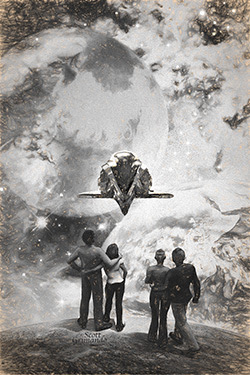
In memoriam Jack Vance: 1916 — 2013

By Anders Monsen

Jack Vance, science fiction grandmaster, died on Sunday, May 26, 2013. Born on August 28 1916, John Holbrook Vance wrote over 50 novels and many more short stories, most published under the name Jack Vance. His works ranged from science fiction and fantasy to mystery and regional fiction. Vance’s first published story was “The World Thinker” in 1945 for Thrilling Wonder Stories, and his first published book The Dying Earth, by Hillman Press in 1950. His last novel, Lurulu, appeared in 2004, and an autobiography in 2009.

Though he was approaching 100, and I always expected to read something about his death, I felt a deep shock when I finally received the news. I have read all his books, many of them multiple times. They are like old friends. I have nominated and voted for many of his works for the Prometheus Hall of Fame. Now he is dead. Will it matter if he ever wins? Would he have cared to have won while still alive? I do not know. Reflecting on his books is like reflecting on the lives of long-time friends.

Continue reading In memoriam Jack Vance: 1916 — 2013

Sinisalo wins Prometheus Award for The Core of the Sun

Prometheus Award ceremony to be held Aug. 11 at Worldcon Helsinki, Finland

The Libertarian Futurist Society has chosen The Core of the Sun, by Johanna Sinisalo, as the 2017 winner in the Best Novel category of the 37th annual Prometheus Awards.

LFS members also voted to induct Robert Heinlein’s story “Coventry” (first published in 1940 in Astounding Science Fiction) into the Prometheus Hall of Fame for best classic fiction.

In a separate awards process, the LFS also recently selected the first chapter of Freefall, a Webcomic by Mark Stanley, to receive a Special Prometheus Award in 2017.

Continue reading Sinisalo wins Prometheus Award for The Core of the Sun

Review: The Corporation Wars: Insurgence, by Ken MacLeod

By Chris Hibbert

Ken MacLeod’s The Corporation Wars: Insurgence is the second book of a trilogy. It (along with the first book in the series, Dissidence, is a finalist for the Prometheus award this year.

Insurgence continues the story of awakened robots struggling for freedom, and uploaded human ex-combatants fighting to retake the planetary system the robots had been mining and exploring.

This installment focuses less on the robots’ claim to be agents worthy of separate respect, and more on the uploaded warriors struggle to figure out the nature of the reality they inhabit while mostly following orders to fight the battles their supervisors are pursuing.

Continue reading Review: The Corporation Wars: Insurgence, by Ken MacLeod

Review: Unusual aliens, libertarian ethics accent L. Neil Smith’s Blade of p’Na

By Tom Jackson

book coverI’ll start my review with a confession. Even though I honor L. Neil Smith for creating the Prometheus Award, and I devote a great deal of time and energy trying to help the award continue, I don’t always love his work.

I enjoyed The Forge of the Elders (the 2011 Prometheus Award-winner for Best Novel) but I didn’t care for Pallas or Ceres very much. Smith the angry libertarian polemicist does little for me, either in the Ngu Family Saga or on Facebook.
Continue reading Review: Unusual aliens, libertarian ethics accent L. Neil Smith’s Blade of p’Na

Ken MacLeod at Edinburgh International Book Festival

Ken MacLeod blogged about being asked to host a series of talks and interviews at the annual Edinburgh Festival (“The largest festival of its kind in the world”).

He brought in luminaries like Stephen Baxter, as well as several Prometheus winning and nominated authors, including Charles Stross, Jo Walton, and Ada Palmer.

Ken MacLeod (Creative Commons photo)

If you will be in the vicinity, consider stopping by.

Review: The Corporation Wars: Dissidence, by Ken MacLeod

By Chris Hibbert

Ken MacLeod’s The Corporation Wars: Dissidence is the first book of a trilogy. It (along with the second book in the series, Insurgence) is a finalist for the Prometheus award this year.

Book CoverThe story starts with a scene in which a pair of mining robots exploring an asteroid (in a distant solar system) and representing different corporate interests have an encounter, which leads them to realize they have opposing interests, which leads them each to recognize that they have interests, which leads them to self-awareness.

The corporations are in a tenuous situation, trying to assert their ownership of the robots, trying to be civil about their contractual cooperation, but objecting strenuously to breaches by the opposing robots.

Continue reading Review: The Corporation Wars: Dissidence, by Ken MacLeod

Freedom in the Future Tense: A Political History of SF


By Eric S. Raymond

The history of modern SF is one of five attempted revolutions — one success and four enriching failures. I’m going to offer a look at them from an unusual angle, a political one. This turns out to be a useful perspective because more of the history of SF than one might expect is intertwined with political questions, and SF had an important role in giving birth to at least one distinct political ideology that is alive and important today.

Robert Heinlein (Photo courtesy of the Heinlein Trust)

CAMPBELL AND HEINLEIN

The first and greatest of the revolutions came out of the minds of John Wood Campbell and Robert Heinlein, the editor and the author who invented modern science fiction. The pivotal year was 1937, when John Campbell took over the editorship of Astounding Science Fiction. He published Robert Heinlein’s first story a little over a year later.
Continue reading Freedom in the Future Tense: A Political History of SF