Besides the late great Michael Flynn, Arc Manor Books has published quite a few other Prometheus-winning authors – including Poul Anderson, Robert Heinlein, Larry Niven, Jerry Pournelle, L. Neil Smith, Harry Turtledove and Jack Williamson.
Two of Arc Manor’s major imprints are CAEZIK SF & Fantasy, launched in 2020 with a “new” previously unpublished novel by Robert A. Heinlein, and Phoenix Pick, which reprints classic SF and Fantasy “from the ashes” of other publishing houses, with some new titles.
Thus, the Maryland-based small-press, created by Shahid Mahmud in 2006 to utilize the exciting new emerging technologies being developed in the publishing marketplace, should be better known, especially by Libertarian Futurist Society members and other freedom-loving sf/fantasy fans.
E.M. Forster isn’t the only Prometheus-recognized author on New Scientist’s intriguing list of the 26 best science fiction/fantasy stories of all time.
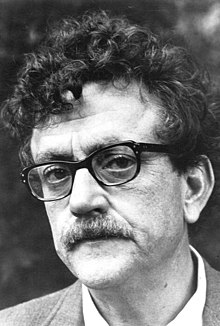
Kurt Vonnegut in 1972 (Creative Commons license)
Although Forster’s “The Machine Stop” is the only story on the list specifically inducted into the Prometheus Hall of Fame, as described in a recent Prometheus blog post, several other enduring authors have stories on the magazine’s list – just not the ones our award has recognized.
Ursula K. Le Guin (Creative Commons license)
Among those writers: Ray Bradbury, Robert Heinlein, Ursula K. Le Guin and Kurt Vonnegut.
It’s interesting to see which of their stories are recognized by the magazine, and why.
David Friedman, a guest presenter at the 45th Prometheus Awards show, is a regular reader of science fiction and fantasy – and the prominent economist and leading libertarian theorist has been influenced in his thinking by several Prometheus-winning authors.
So it’s interesting to hear Friedman’s views on a variety of sf/fantasy writers, which he shared in response to questions at the end of the Aug. 30, 2025, awards ceremony.
In addition to Poul Anderson (the 2025 Hall of Fame winner for Orion Shall Rise), Robert Heinlein, Jerry Pournelle and Vernor Vinge (Prometheus-winning writers that Friedman discussed during his main speech), Friedman offered comments and insights on the novels of Prometheus winners Lois McMaster Bujold, L. Neil Smith, J. Neil Schulman, C.J. Cherryh (highlighted in a previous blog), Heinlein and other sf/fantasy writers.
David D. Friedman added excitement and intellectual stimulation as the guest presenter at the 45th Prometheus Awards ceremony.
David Friedman (Photo provided by Friedman)
A leading libertarian theorist (The Machinery of Freedom), economist (Price Theory: An Intermediate Text) and law-and-economics professor (Law’s Order: What Economics Has to Do with Law and Why It Matters), David is also a Prometheus-nominated sf/fantasy novelist (Harald, Salamander, Brothers).
Friedman presented the Prometheus Hall of Fame category for Best Classic Fiction during the Aug. 30 ceremony. Here is the text of his speech, which followed an introduction by LFS President William (Bill) Stoddard.
By David D. Friedman
Bill mentioned my friend Vernor Vinge, who is in part responsible for my writing my second novel.
I described to him my idea for that and for the alternative, a sequel to my first novel (Harald, a 2007 Prometheus Best Novel nominee). He thought Salamander would more interesting, so I wrote it. He was right.
I thought I’d start by saying a little about what I’ve learned relevant to libertarianism from science fiction.
As some of you may know, Vernor’s story “The Ungoverned” (inducted in 1994 into the Prometheus Hall of Fame) is about a stateless society, modeled on my ideas, being invaded by an adjacent state.
Seeing that society through the eyes of a novelist rather than an economist showed me things about it that would not have occurred to me….
Imagine human colonies on the moon, restless and on the precipice of a revolution against increasingly intrusive Earth authorities.
Robert Heinlein famously imagined such a scenario in The Moon is a Harsh Mistress, one of his four Hugo Awardwinning novels and one of the first two works inducted in 1983 into the Prometheus Hall of Fame for Best Classic Fiction.
So did Travis Corcoran, the only author to win back-to-back Prometheus awards for Best Novel for The Powers of the Earth (in 2018) and its sequel Causes of Separation (in 2019.)
Yet, the lunar-revolution scenario mentioned above also describes Dust Mites: The Siege of Airlock Three, James Bacon’s 2022 SF novel.
Winning literary awards and receiving rave reviews can boost the careers of novelists, by raising their visibility and enhancing their reputation. That’s sadly no longer fully possible for the late great Michael Flynn.
Michael Flynn, a three-time Prometheus Best Novel winner (Creative Commons license)
Flynn, who died in 2023 at 75, recently was announced in an LFS press release as the 2025 winner of the Prometheus Award for Best Novel for In the Belly of the Whale.
His epic social novel, a sobering drama about challenges and conflicts among the crew on a vast colony ship two centuries into a projected eight-century voyage to settle Tau Ceti, was the last novel Flynn wrote before his death.
Published in 2024 by CAEZIK SF & Fantasy, Flynn’s novel has garnered some attention – especially an extraordinary review in Locus magazine (excerpted below) that amounts to a mea culpa for previously overlooking and underestimating Flynn.
Yet, both during his five-decade writing career and after his passing, Flynn has not garnered as much attention and appreciation from other critics and mainstream publications as I think the author and his last book deserve.
Shahid Mahmud, CAEZIK founder-publisher and a huge enthusiast for Flynn’s fiction, agrees. Mahmud tells me that he considers Flynn one of the most underestimated science fiction writers of his generation.
Alliance Unbound is the sequel to Alliance Rising, which won the Prometheus Award for Best Novel in 2020. It appears that this may be the second volume of a trilogy, as the final pages leave important issues unresolved.
Taken together, these novels form a prequel to Cherryh’s Alliance/Union series, one of the larger future histories in the past few decades. (It began in 1981 with Downbelow Station, which won her first Hugo Award for best novel.)
The crucial fact driving its events is scarcity.
There are only three planets with biospheres: Earth, Pell’s World, and Cyteen. Orbital habitats in other solar systems — notably Alpha Station, located at Barnard’s Star, where Alliance Rising was set — are ultimately dependent for supplies, especially biomass, on those three systems; Alliance Rising’s plot turned on Earth’s starving Alpha Station of resources to advance its own goals, and a key point in Alliance Unbound is the discovery of nearly priceless Earth goods on Downbelow Station, which orbits Pell’s World.
Cherryh and Fancher’s characters are well aware of such issues of scarcity and value, being interstellar merchants who spend their lives going from solar system to solar system, with holds full of high-value cargo and computer memories full of equally valuable data.
An illustration in Dave Freer’s novel Storm-Dragon (Image provided by author
Prometheus winner Dave Freer has a new novel coming out soon.
Storm-Dragon, to be published April 11, 2025, by Raconteur Press, is a relatively short novel (with illustrations) geared toward a young-adult audience – and especially targeted at boys and teenagers.
“It is my attempt at writing a Heinlein “Juvie” – a book aimed specifically at teen boys (not their scene) to get them interested in sf,” Freer said in an email from his home base Down Under in the Australian state of Tasmania.
Several Prometheus-recognized authors are included on New Scientist’s intriguing list of the 26 best science fiction/fantasy stories of all time.
Ray Bradbury (Creative Commons license)
E.M. Forster’s “The Machine Stops” is the only story on the magazine’s list previously inducted into the Libertarian Futurist Society’s Prometheus Hall of Fame. Yet, several other enduring and Prometheus-winning authors have classic stories on the magazine’s list – just not the ones our award has recognized.
Among them: Ray Bradbury, Robert Heinlein, Ursula K. Le Guin and Kurt Vonnegut.
It’s interesting to see which of their stories are recognized by the magazine, and why.
Many libertarians and other freedom-loving SF fans know that term well. For those who don’t recall, it’s an acronym for “There Ain’t No Such Thing as a Free Lunch.”
The Grand Master SF writer Robert Heinlein did his share to popularize the acronym in The Moon is a Harsh Mistress. His bestselling, Hugo-winning novel, about a libertarian revolution on the Moon, was one of the first works inducted into the Prometheus Hall of Fame.
So did free-market economist and classical liberal Milton Friedman, who often quoted it over the years.
Both libertarians used the acronym to communicate the idea that nothing is truly free, and there’s always a cost to any decision.
But did the popular catchphrase inadvertently also spread a misunderstanding about economics?