
Size matters – or at least it can make a big difference, in helping a novel to achieve greater dramatic impact in its scope, depth, narrative complexity and emotional power.

Quite a few longer novels have been recognized by the Prometheus Awards over the past 47 years, whether as nominees, finalists or winners – from J.R.R. Tolkien’s The Lord of the Rings, Neal Stephenson’s Cryptonomicon and Ayn Rand’s Atlas Shrugged to the recent nomination of Sarah Hoyt’s three-volume No Mans Land for the next Prometheus Award for Best Novel.
The three classic and epic works by Tolkien, Stephenson and Rand rank No. 1, 2 and 3 in page length in the history of the Prometheus Awards – as detailed in previous Prometheus Blog articles about the three bestselling winners and No Man’s Land.
So what are all the Prometheus-recognized novels and their ranks in page lengths on our top-12 list?
Compiled from researching the main Prometheus Awards page listing all 110 winners and the secondary LFS website pages listing all nominees and finalists for Best Novel and for the Hall of Fame for Best Classic Fiction, here’s the ranked list:

THE DOZEN LONGEST PROMETHEUS-RECOGNIZED NOVELS
1. 1206 pages – J.R.R. Tolkien’s The Lord of the Rings, the 2009 Hall of Fame winner
2. 1168 pages – Neal Stephenson’s Cryptonomicon, the 2013 Hall of Fame winner
 3. 1115 pages – Ayn Rand’s Atlas Shrugged, a 1983 Hall of Fame inductee (inducted into the first Hall of Fame along with Robert Heinlein’s The Moon is a Harsh Mistress)
4. 1056 pages – Neal Stephenson’s REAMDE, a 2012 Best Novel nominee

5. 1011 pages – Karl Gallagher’s Torchship trilogy (Torchship, Torchship Pilot, and Torchship Captain, which together tells one complete story about a free-enterprising starship captain and crew striving to make enough profit to keep themselves afloat while avoiding the attention of a coercive and intrusive government.
Under our award rules, such a complete story – as opposed to a usual three-novel trilogy – can be and was combined into one nomination, becoming a 2018 Best Novel finalist.
6. 960 pages – Neal Stephenson’s Anathem, a 2009 Best Novel nominee

7. 928 pages – Neal Stephenson’s The System of the World, the 2005 Best Novel winner and the culmination of his ambitious Baroque Cycle trilogy about the emergence of the modern classical-liberal/libertarian socioeconomic order shaped by the progress of reason, science, technology, free markets, respect for individual rights and the abolition of slavery.
8. 917 pages – Neal Stephenson’s Quicksilver, a 2004 Best Novel nominee and the first novel of the Baroque Cycle trilogy, followed by the Prometheus-nominated sequel The Confusion, at 810 pages.

9. 900 pages – Sarah Hoyt’s No Man’s Land, a three-volume 2025 novel nominated for the next Prometheus Award for Best Novel
10. 892 pages – Neal Stephenson’s Fall, or Dodge in Hell, a 2020 Best Novel nominee

11. 880 pages – Neal Stephenson’s Seveneves, the 2019 Prometheus Best Novel winner dramatizing how politics and the lust for power almost wipes out our species when a cataclysmic event and its long aftermath threatens our planet while a commitment to reason, individual initiative and the voluntary cooperation of private enterprise help tip the balance towards survival.
 12. 870 pages – J.K. Rowling’s Harry Potter and the Order of the Phoenix, a 2004 Best Novel finalist, Book 5 of Harry Potter’s adventures and both the longest and most libertarian of her bestselling seven-volume coming-of-age series about good, evil, power and the abuse of power.
THE EPIC VISIONS OF NEAL STEPHENSON
The first thing that leaps out from looking over the above list is how many of Stephenson’s novels appear on it.

Perhaps it’s no accident that Stephenson has seven of the 12 longest novels on the above list.
After all, Stephenson is famous – in some quarters, even notorious – for writing longer novels, often exploring complex themes rooted in history and the development of technology.
And while his novels sometimes weave in fascinating tangents or subplots offering insightful stories and observations about little-known but important subjects that shape our world, readers are usually well-rewarded for their attention.
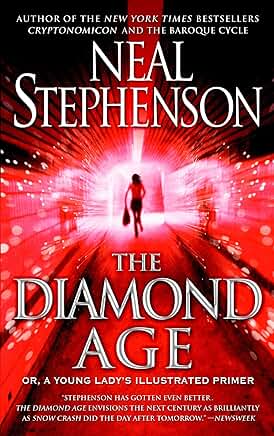 First recognized in our awards in 1996 when his seminal The Diamond Age became a Best Novel finalist and since widely recognized as one of the best SF writers of the past three decades, Stephenson has enough skills, vision, talent and wisdom to pull off his feats of large-scale fiction.
OTHER LONGER NOVELS
Although they don’t quite make it onto the above list, here are three other substantive, longer and rewarding novels that have won Prometheus Awards:
 640 pages – L. Neil Smith’s The Forge of the Elders, the 2001 Best Novel winner about a culture clash and political differences between a group of statist humans who encounter libertarian aliens on an expedition to an asteroid
 608 pages – Vernor Vinge’s A Deepness in the Sky, the 2000 Best Novel winner and a first-rate example of the New Space Opera
522 pages – John Varley’s The Golden Globe, the 1999 Best Novel winner and one of the relatively few comedies to win our award
Also of note: Neal Stephenson’s 716-page Termination Shock, a 2023 Best Novel nominee; and Donald Kingsbury’s 512-page Psychohistorical Crisis.
Such longer works of fiction may face a daunting challenge in an era when every-day or even every-year reading of books is sadly on the decline, and when the government-run compulsory public-school system is increasingly turning out junior-high and high-school graduates who still don’t know how to read (or read so poorly that they are handicapped in their lives and careers.).
 Yet, reading novels – including immersive longer works that offer more depth, more heights and more room for the imagination to linger and blossom – remains one of the great pleasures in life.
So if you haven’t had a chance to familiarize yourself with some of the above novels, perhaps because you were daunted by their above-average length, take the time to read one in 2026.
You might be pleasantly surprised by how much more gripping and involving a work of epic scope can be – if you have the time and patience to read it.
FOR FURTHER READING
Check out two related previous Prometheus Blog articles about the unusual three-volume format and greater length of Sarah Hoyt’s nominated No Man’s Land and the enduring appeal of the three longest Prometheus winners: The Lord of the Rings, Cryptonomicon and Atlas Shrugged.

ABOUT THE LFS AND THE PROMETHEUS AWARDS
* Join us! To help sustain the Prometheus Awards and support a cultural and literary strategy to appreciate and honor freedom-loving fiction, join the Libertarian Futurist Society, a non-profit all-volunteer international association of freedom-loving sf/fantasy fans.
Libertarian futurists understand that culture matters. We believe that literature and the arts can be vital in envisioning a freer and better future. In some ways, culture can be even more influential and powerful than politics in the long run, by imagining better visions of the future incorporating peace, prosperity, progress, tolerance, justice, positive social change, and mutual respect for each other’s rights, human dignity, individuality and peaceful choices.
* Prometheus winners: For a full list of Prometheus winners, finalists and nominees – including in the annual Best Novel and Best Classic Fiction (Hall of Fame) categories and occasional Special Awards – visit the enhanced Prometheus Awards page on the LFS website. This page includes convenient links to all published essay-reviews in our Appreciation series explaining why each of more than 100 past winners since 1979 fits the awards’ distinctive dual focus on both quality and liberty.
* Watch videos of past Prometheus Awards ceremonies, Libertarian Futurist Society panel discussions with noted sf authors and leading libertarian writers, and other LFS programs on the Prometheus Blog’s Video page.
* Read “The Libertarian History of Science Fiction,” an essay in the international magazine Quillette that favorably highlights the Prometheus Awards, the Libertarian Futurist Society and the significant element of libertarian sf/fantasy in the evolution of the modern genre.
* Check out the Libertarian Futurist Society’s Facebook page for comments, updates and links to the latest Prometheus Blog posts.

The length of Neal Stephenson’s novels may explain why he has no time for emails, as explained in his article:
Why I Am a Bad Correspondent
https://www.nealstephenson.com/why-i-am-a-bad-correspondent.html
Great article. I, too, have always found the thicker the novel the more my interest in reading it — partly because I assume the author must of really loved writing it too.
The longest novel I wrote was 500 pages (150,000 words — roughly the same legth as “The Two Towers”) and I could have easily kept going but needed to get it published (after 1,000 hours of work over two years) and figured a cliffhanger and a trilogy would be easier to market.