
By Michael Grossberg
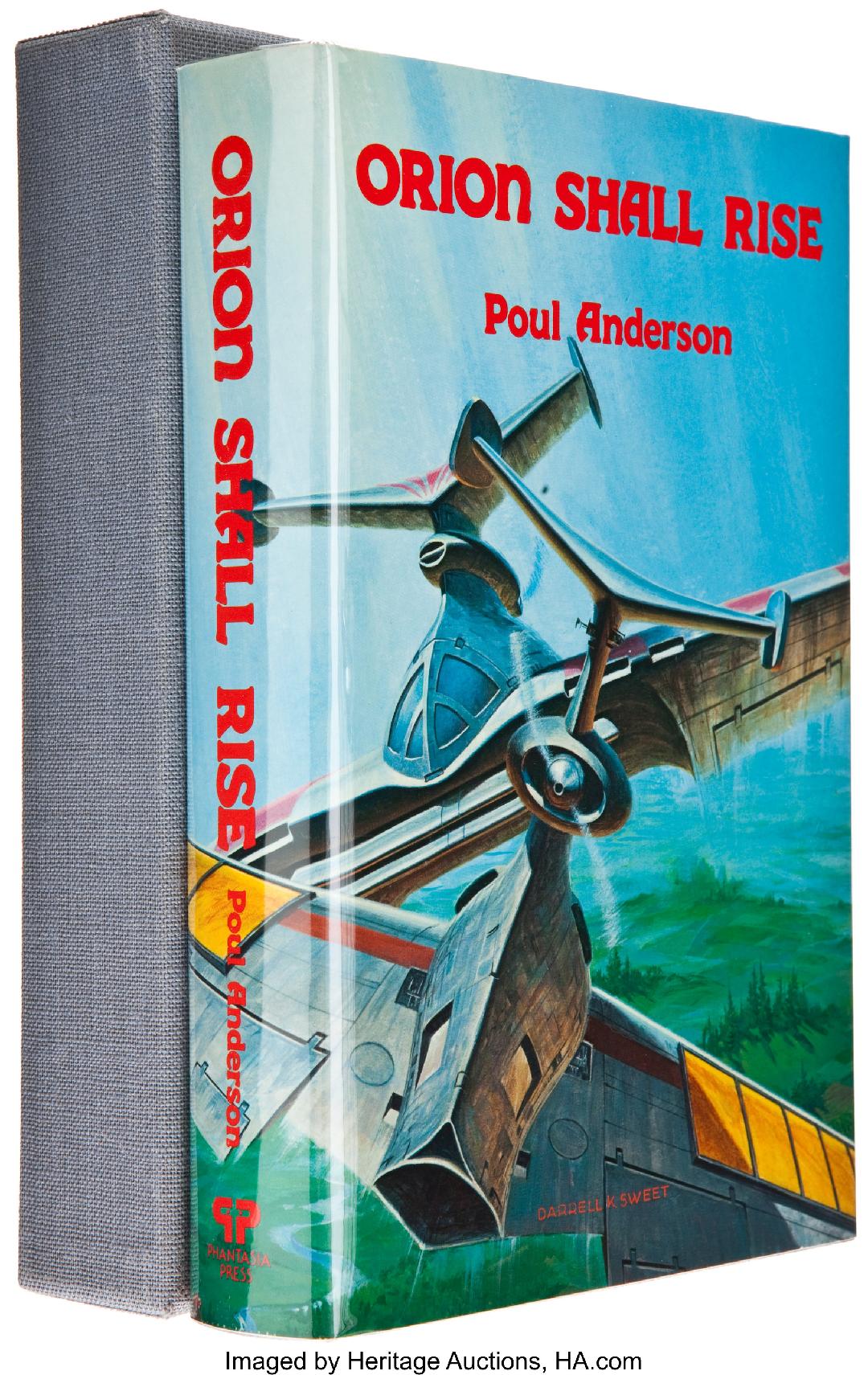
With Poul Anderson’s Orion Shall Rise inducted most recently into the Prometheus Hall of Fame for Best Classic Fiction, it’s interesting to look back on our initial review of the 1983 novel for its insights and first impressions.
Victoria Varga, the first LFS Director and editor of the print edition of Prometheus from 1983 to 1988, reviewed Anderson’s science fiction novel when it was first nominated for a Prometheus Award for Best Novel.
Thanks in part to her positive review, Orion Shall Rise was selected by Libertarian Futurist Society members as a 1984 Best Novel finalist (the year that J. Neil Schulman’s The Rainbow Cadenza won our award.)
Most notably, Varga praised Anderson for doing “a brilliant job of creating mythologies, religious and secular, for his characters and their civilizations.”
Varga’s review also identifies a key character linking all four civilizations, one with an outside and more objective perspective that illuminates this dark but hopeful future.

Varga also provides context for the novel by reminding us that in several cases, the four different post-apocalyptic societies that have developed on Earth were previously developed and dramatized in Anderson’s short stories.
“Anderson does a good job with all this complexity partly because he has, in various short stories over the years, worked out many of the details of these societies. In addition, his evolving ideas about the conflict between economic expansion and ecological balance allows him to examine sympathetically all sides of his characters’ controversial debate,” Varga wrote in the July 1984 quarterly issue of Prometheus (Vol. 2, No. 3.)
“It is interesting to note that Anderson, by the evidence of those previously mentioned short stories (beginning with “Sky People” in 1959), believed the Maurai way to be the best,” she observed.
“Now he is more critical of any plan to stop progress by force, and at the same time he demonstrates that nuclear power can be (if used in weapons) misused by the power hungry.”
Earlier in Varga’s review she describes the four civilizations that co-exist, sometimes uneasily, on Earth.
“The Mong are mostly great-grandchildren of Asians that migrated over a Bering Strait ice bridge to settle mid-North America. The Domain consists of remnants of European civilization held together and protected by Skyholm, a centuries-old warship/palace floating in the stratosphere. The northwest Union is a lodge-based anarchist society desiring technological advancement—particularly nuclear power.”

“Dominating them all are the Maurai descendents of native New Zealanders, whose anti-technological viewpoint forces the Northwest Union to keep their nuclear-powered spaceship project secret. This project is the “Orion” of the book’s title.”
“… Understandably, most of the world considers nuclear weapons and nuclear power terrifyingly dangerous and any attempt to build or use either as aggression against all humanity.”

One character ties together the story and this world.
Plik, “a continually soused troubadour,” gets to know the main characters and participate in most of the action, almost by chance, Varga observed.
Plik is the character who makes explicit one of the deepest and most libertarian themes in the 2025 Prometheus awardwinner.
He “warns them again and again that they are creating a new power myth (one that he very much fears and one they might not be able to control). But the myth evolves as the whole world realizes the necessity of freedom and the devastating consequences of the use of force.”

ABOUT POUL ANDERSON
Poul Anderson (1926-2001) was a major American science fiction writer who won the Hugo Award seven times, the Nebula Award three times and the Prometheus Award seven times (including this year’s award and the first Special Prometheus Award for Lifetime Achievement).
Orion Shall Rise is the fifth work by Anderson to be inducted into the Prometheus Hall of Fame, following Trader to the Stars (in 1985), The Star Fox (in 1995), “No Truce with Kings” (in 2010) and “Sam Hall” (in 2020.)

ABOUT THE PROMETHEUS AWARDS AND THE LFS
* Join us! To help sustain the Prometheus Awards and support a cultural and literary strategy to appreciate and honor freedom-loving fiction, join the Libertarian Futurist Society, a non-profit all-volunteer association of freedom-loving sf/fantasy fans.
Libertarian futurists understand that culture matters. We believe that literature and the arts can be vital in envisioning a freer and better future. In some ways, culture can be even more influential and powerful than politics in the long run, by imagining better visions of the future incorporating peace, prosperity, progress, tolerance, justice, positive social change, and mutual respect for each other’s rights, human dignity, individuality and peaceful choices.
* Prometheus winners: For a full list of Prometheus winners, finalists and nominees – including in the annual Best Novel and Best Classic Fiction (Hall of Fame) categories and occasional Special Awards – visit the enhanced Prometheus Awards page on the LFS website. This page includes convenient links to all published essay-reviews in our Appreciation series explaining why each of more than 100 past winners since 1979 fits the awards’ distinctive dual focus on both quality and liberty.
* Watch videos of past Prometheus Awards ceremonies, Libertarian Futurist Society panel discussions with noted sf authors and leading libertarian writers, and other LFS programs on the Prometheus Blog’s Video page.
* Read “The Libertarian History of Science Fiction,” an essay in the international magazine Quillette that favorably highlights the Prometheus Awards, the Libertarian Futurist Society and the significant element of libertarian sf/fantasy in the evolution of the modern genre.
* Check out the Libertarian Futurist Society’s Facebook page for comments, updates and links to the latest Prometheus Blog posts.

I agree with most of Varga’s points, and made similar points in my own much later review. But I don’t think it’s so clear cut that nuclear weapons are “misused by the power hungry” in Anderson’s novel. The appalling thing about nuclear weapons is their wide area of effect, which almost inevitably damages civilian targets and kills civilians. But in Orion Shall Rise, an atomic weapon is used to attack a military force moving through unoccupied terrain to invade the Northwest Union. What Anderson has done is to show us a case the use of such a weapon is clearly morally legitimate—even though the consequences are horrific, and include the death of Vanna Uangovna Kim, perhaps the most admirable character in the novel. I think all this is consistent with Anderson’s often tragic sense of life.