
As a guide to the Prometheus Awards and for the convenience of Libertarian Futurist Society members, the Prometheus Blog has once again published full-length and in-depth reviews of all of this year’s Prometheus Hall of Fame finalists for Best Classic Fiction.

Libertarian Futurist Society members, who have the right to vote to select the annual Best Classic Fiction winner from the finalists, are invited to read our reviews of the five novels selected as 2026 finalists – hopefully, to whet your appetite to read each finalist and vote in this year’s Prometheus Awards.
First published between 1932 and 2003, the five finalists were written by James Blish (The Star Dwellers), C.S. Lewis (That Hideous Strength), Aldous Huxley (Brave New World), Adam Roberts (Salt) and Charles Stross (Singularity Sky).
Other SF/fantasy fans and other libertarians, outside the LFS, also are invited to check out the reviews to better understand how they fit the distinctive dual focus of the Prometheus Awards on both quality and liberty.
Here is a capsule description of each finalist, followed by the link to the Prometheus blog review:
THE STAR DWELLERS
 The Star Dwellers, a 1961 novel (Faber and Faber; Avon Books) by James Blish, revolves around a fraught potential conflict between humans and an ancient species of energy beings born inside stars.
A young space cadet serving on a small scout starship finds himself alone and at a pivotal moment, prompting him to forge a friendship with one of the youngest Angels. Their efforts at communication and bargaining result in a deal that opens the door to wider negotiations toward a historic treaty of cooperation and peaceful co-existence.
Powerfully but simply dramatizing how voluntary exchanges and free trade benefit both parties, Blish’s idealistic SF juvenile novel illuminates the virtues of consent and contract — two of the most fundamental ideas at the foundation of both libertarianism and classical liberalism — as the civilized alternatives to conflict and war.
Read the full-length review of The Star Dwellers.
BRAVE NEW WORLD
 Brave New World, a 1932 novel (Chatto & Windus) by Aldous Huxley, is a dystopian classic offering a still-timely cautionary tale of collectivist soft tyranny under seemingly benevolent world government and technocratic central planning.
Critiquing his era’s rise of collectivism and Progressive infatuation with the racist pseudo-science of eugenics, Huxley warned about behavioral/biochemical conditioning, propaganda, censorship and manipulation of artificial wombs limiting intelligence and initiative to create and control different castes.
At a time when the intellectual and artistic elite saw most forms of authoritarian collectivism as the inevitable and positive wave of the future, Huxley foresaw the dark side of utopia. The novel explicitly dramatizes how such trends deny individuality, liberty, reason, passion, romantic love, the family, history, literature (including Shakespeare, which inspired the novel’s title) and other things that enrich distinctly human life.
Read the full-length review of Brave New World.
THAT HIDEOUS STRENGTH
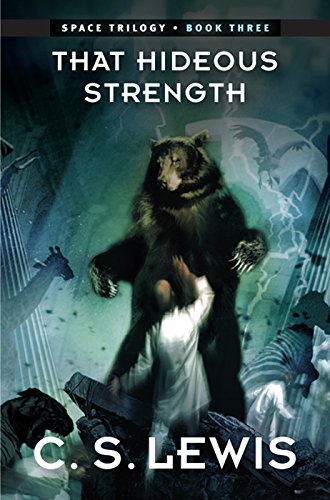 That Hideous Strength, a 1945 novel (Scribner) by C. S. Lewis, is the climax of the Christian libertarian’s Space Trilogy. Set mostly on Earth, Lewis’ dystopian and metaphysical vision dramatizes warring ideologies of good and evil, freedom and tyranny.
The story revolves around a sociologist and his wife who discover a totalitarian conspiracy and diabolical powers scheming to control humanity in the guise of a progressive-left, Nazi-like organization working for a centrally planned pseudo-scientific society literally hell-bent to seize power.
Evoking a police state in the takeover of a local village and warning about the dangers of bureaucracy, Lewis seems most prophetic today in his cautions about the therapeutic state and rising ideology of scientism (science not as the value-free pursuit of truth, but as elitist justification for social control).
Read the full-length review of That Hideous Strength.
SALT

Salt, a 2000 novel (Gollancz Limited) by Adam Roberts, dramatizes misunderstandings and growing conflicts between an anarchist community and its statist neighbor.
Set on a harsh desert-like colony world, Robert’s impressive first novel contrasts radically different conceptions of liberty. Evoking Ursula K. Le Guin’s Prometheus-winning The Dispossessed in its depiction of alternative dystopian/utopian societies, Roberts’ cautionary science fiction story underscores how pro-freedom rhetoric can rationalize transgressions and how skewed ideals and good intentions can lead people astray.
Told in alternating chapters by the two societies’ biased leaders, this libertarian tragedy poignantly reveals how cross-cultural misunderstandings can spark the horrors of war. Although each society is flawed and falls short of respecting the individual rights, self-ownership and non-aggression principles of modern libertarianism, Salt provokes fresh thinking about the true meaning of freedom.
Read the full-length review of Salt.
SINGULARITY SKY
 Singularity Sky, a 2003 novel (Ace Books) by Charles Stross, dramatizes the ethics and greater efficacy of freedom in an interstellar 25th century as new technologies trigger radical transformation – strikingly beginning with advanced aliens dropping cell phones from the sky to grant any and all wishes.
Blending space opera with ingenious SF concepts (such as artificial intelligence, bioengineering, self-replicating information networks and time travel via faster-than-light starships), the kaleidoscopic saga explores the disruptive impact on humanity as various political-economic systems with varying degrees of freedom come into contact.
Stross weaves in pro-liberty and anti-war insights as an observant man and woman, representing Earth’s more libertarian culture and anarcho-capitalist economy based on private contracts, interact with a repressive and reactionary colony, its secret police and its military fleet.
Read the full-length review of Singularity Sky.

LOOKING AHEAD TO THE FINAL MONTHS OF READING AND VOTING
With the Prometheus Best Novel judges still hard at work reading and discussing this year’s 14 Best Novel nominees, the slate of Best Novel finalists is not expected to be finalized and announced until mid-April.
For LFS members who plan to vote in both annual Prometheus categories this year, that creates an opening over the next two months to concentrate on reading the Hall of Fame finalists.
Once the Best Novel finalists are announced, LFS members will have just over 2 1/2 months to read those finalists and finish reading the Hall of Fame finalists.
As always, LFS members will receive by email the official Prometheus Awards ballot by early June, with our traditional and aptly symbolic voting deadline annually set for the Fourth of July, American Independence Day.

ABOUT THE LFS AND THE PROMETHEUS AWARDS
* Join us! To help sustain the Prometheus Awards and support a cultural and literary strategy to appreciate and honor freedom-loving fiction, join the Libertarian Futurist Society, a non-profit all-volunteer international association of freedom-loving sf/fantasy fans.
Libertarian futurists understand that culture matters. We believe that literature and the arts can be vital in envisioning a freer and better future. In some ways, culture can be even more influential and powerful than politics in the long run, by imagining better visions of the future incorporating peace, prosperity, progress, tolerance, justice, positive social change, and mutual respect for each other’s rights, human dignity, individuality and peaceful choices.
* Prometheus winners: For a full list of Prometheus winners, finalists and nominees – including in the annual Best Novel and Best Classic Fiction (Hall of Fame) categories and occasional Special Awards – visit the enhanced Prometheus Awards page on the LFS website. This page includes convenient links to all published essay-reviews in our Appreciation series explaining why each of more than 100 past winners since 1979 fits the awards’ distinctive dual focus on both quality and liberty.
* Watch videos of past Prometheus Awards ceremonies, Libertarian Futurist Society panel discussions with noted sf authors and leading libertarian writers, and other LFS programs on the Prometheus Blog’s Video page.
* Read “The Libertarian History of Science Fiction,” an essay in the international magazine Quillette that favorably highlights the Prometheus Awards, the Libertarian Futurist Society and the significant element of libertarian sf/fantasy in the evolution of the modern genre.
* Check out the Libertarian Futurist Society’s Facebook page for comments, updates and links to the latest Prometheus Blog posts.

It’s surprising to see Brave New World has not already won the award — being the classic dystopian story that it is — but on the other hand, I can understand why: I can’t say I enjoyed the book.
The Hideous Strength feels much more deserving. The other books I have not read, but look forward to checking out — Star Dwellers sounds particularly interesting.