
John Varley, winner of the 1999 Prometheus Award for Best Novel, is being remembered for his intelligent, imaginative, cutting-edge science fiction.
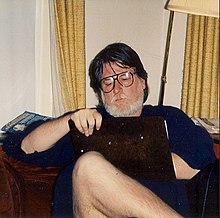
Varley, who died in December at the age of 78 in Beaverton, Oregon, was “truly one of the greatest science fiction authors of all time,” wrote his fellow sf writer and friend David Brin in a tribute in the just-published January 2026 issue of Locus magazine.
An American science fiction writer (1947-2025), Varley often was Heinleinesque in his positive vision of human resilience and innovation and his ability to tell stories that blended adventure, suspense, believable characters, intelligent world-building and an epic sense of wonder.
In fact, Varley’s work often has been compared to frequent Prometheus winner Robert Heinlein, especially by the Canadian SF critic-author John Clute. So it made a lot of sense when Varley received the Robert A. Heinlein Award in 2009.
“He was fresh, he was complex, he understood the imaginative implications of transformative developments,” Clute wrote about Varley in his entry in the Encyclopedia of Science Fiction.
According to the obit in Locus magazine, Varley suffered from COPD and diabetes.

Suffering a quadruple bypass, COVID-19 and bacterial pneumonia and other health problems in 2021, Varley largely became unable to write, sparking a crowdfunding campaign organized by colleagues to cover his expenses.
Yet during the decades when Varley was able to write, he created a body of work that helped define contemporary science fiction.
Varley won Hugo, Nebula and Locus awards for his novellas “The Persistence of Vision” and and “PRESS ENTER ■.”
VARLEY’S “THE EIGHT WORLDS” SERIES
Many of Varley’s best novels and stories are set within “The Eight Worlds,” a future history in which most of our solar system has been colonized.
His complex and multifaceted world-building offered ample room for stories, with human beings having established settlements and colonies in virtually every other corner of the solar system after mysterious and powerful aliens almost completely eradicated humans from the Earth to protect whales and dolphins, which they regard as superior lifeforms.

“His Eight Worlds universe explored so many brash concepts that were both science-grounded and brave/prophetic for their time – like a future when people might change their sex/gender as an outpatient procedure, many times in life… and exploring what it even means to claim that humans are ‘intelligent life,” wrote Brin, himself a Prometheus Best Novel finalist in 1988 for The Uplift War.
 Varley also wrote the acclaimed and epic Gaean trilogy of visionary sf novels, which include Titan, Wizard and Demon and begin with humanity’s exploration of a massive satellite orbiting Saturn that opens the door to alien contact.
VARLEY’S PROMETHEUS WINNER: THE GOLDEN GLOBE
Nominated 15 times for a Hugo Award, nine times for a Nebula award and 40 times for a Locus Award, Varley won his Prometheus Award for The Golden Globe.
The title of the novel refers to Earth’s Moon, the most heavily inhabited world in the solar system since alien invaders obliterated human civilization on Earth.
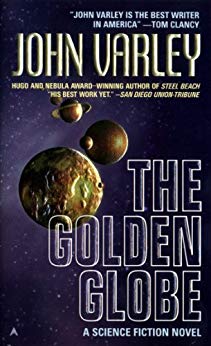 Loosely situated as Book 3 within his Eight Worlds future history (which includes the novels The Ophiuchi Hotline, Steel Beach, Irontown Blues, and Gens de La Lune, among others), The Golden Globe takes place a few years after the conclusion of Steel Beach.
Told mostly in first person by Kenneth “Sparky” Valentine, an itinerant actor and skilled con man, with many flashbacks, The Golden Globe offers an often comic account of his adventures in the solar system’s outer worlds as he makes his way to Luna.
Ultimately, after reclaiming his fortune from his years as the child star of a popular children’s adventure show Sparky and His Gang, Valentine joins forces with the Heinleiners, described as a reclusive group of libertarian idealists who are building a starship and planning a voyage to the stars.
In the Prometheus Blog’s Appreciation essay-review of The Golden Globe, Varley’s novel is hailed as a rare picaresque sf comedy among Best Novel winners.
“Beyond its anti-authoritarian humor and spirit, The Golden Globe appeals to libertarians as a portrait of a poor but free man, striving to maintain his independence and support himself through his own wits and resourcefulness.
“The novel also works as a Heinleinesque romance of space adventure, with Sparky’s odyssey propelled by an extended chase as he struggles to stays mere steps ahead of the Charonese mafia while heading for Luna to perform in King Lear – aptly symbolic here as one of Shakespeare’s most mature dramas with the wisdom and perspective of old age, folly and regret.”
VARLEY’S STORIES ON SCREEN
More than most science fiction writers, Varley saw several of his works move from page to screen.
His Eight Worlds story “Overdrawn at the Memory Bank” was adapted for a PBS movie starring Raul Julia in 1984, while his short stories “Options” and “Blue Champagne” were adapted for episodes of Welcome to Paradox, a 1998 Sci-Fi Channel TV series.

Perhaps most widely seen of Varley’s work was the film Millennium, a dystopian time-travel drama starring Kris Kristofferson, Cheryl Ladd, Robert Joy, Brent Carver and Daniel J. Travanti.
Varley wrote the screenplay based on “Air Raid,” his 1977 short story about an anomaly related to the passengers of a commercial airliner about to be struck by another plane from above. Kristofferson plays a National Transportation Safety Board investigator of the accident who becomes involved with a mysterious woman (Ladd) with a desperate mission from a distant future.
A PERSONAL REMINISCENCE
Speaking personally, I’m a big fan of Varley’s novels – not only The Golden Globe, one of the few that centers libertarian themes, but also his Gaea trilogy and many of the other works in and outside his “Eight Worlds’ series.
 So it was thrilling to meet and interact with Varley in 2016 at Milehicon, Colorado’s largest annual sf convention in Denver.
Attending Milehicon that year primarily to present a Special Prometheus Award for Lifetime Achievement to L. Neil Smith (The Probability Broach, Pallas, The Forge of the Elders) as part of the program, I also spoke on several panel discussions and served as a panel moderator.
That’s when I was fortunate to sit next to Varley, who happened to be speaking on that panel. It was interesting to interact with him during the panel, but the opportunity to chat with him before and after was especially satisfying – and seems more precious in retrospect.
Of course, I gushed like a fan about his work. And when I mentioned that The Golden Globe ranked high among my favorite Varley novels – and not simply because it won the Prometheus Award, but especially because of its humor and rollicking sense of adventure – Varley seemed especially appreciative.
As I recall, Varley mentioned that The Golden Globe had not been as widely praised or widely read as some of his other fiction, but it was one of his favorites, and partly because of its comic dimensions.
So he especially appreciated its recognition in the Prometheus Awards. And I’m glad that the LFS could recognize Varley.
For more information about Varley’s life and writings, visit varley.net
VARLEY’S 1999 BEST NOVEL ACCEPTANCE SPEECH
Here is an excerpt from Varley’s acceptance speech:
“I am particularly gratified to receive this award for The Golden Globe, which—in my opinion—is my best novel so far. I certainly worked harder on this one than I ever have before.
“Also I did more research than I ever have. I had to learn a lot about the theater, so I watched every one of Shakespeare’s plays at least once….
“Michael Grossberg, in his review for the Libertarian Futurist Society, described my book as “a hilarious libertarian comedy and picaresque adventure, with a wonderfully irreverent antiauthoritarian spirit.” That is pretty much what I was aiming for.
“But I have to admit, I wasn’t specifically thinking “libertarian” when I wrote it. I am not a member of any political party, though if I were to join one it would probably be the Libertarians.
 Actually, to my knowledge, I am not now a member of anything except the History Book Club, which I only joined to get their four free books and now can’t seem to resign from, no matter how hard I try. I made it a policy many years ago never to join anything and never to respond to polls or surveys. But “antiauthoritarian” and “irreverent” are words I like, particularly when applied to me or my work. “Picaresque” I’m going to have to look up.”

“You can’t say Libertarian without thinking of Robert A. Heinlein, and I was gratified to see his work well-represented in the list of past Prometheus and Hall of Fame Award winners. I have tried to pay homage to his influence both in The Golden Globe and in my previous book, Steel Beach.
Read Varley’s full acceptance speech, published in the Fall 1999 issue of the Prometheus print quarterly.

ABOUT THE LFS AND THE PROMETHEUS AWARDS
* Join us! To help sustain the Prometheus Awards and support a cultural and literary strategy to appreciate and honor freedom-loving fiction, join the Libertarian Futurist Society, a non-profit all-volunteer international association of freedom-loving sf/fantasy fans.
Libertarian futurists understand that culture matters. We believe that literature and the arts can be vital in envisioning a freer and better future. In some ways, culture can be even more influential and powerful than politics in the long run, by imagining better visions of the future incorporating peace, prosperity, progress, tolerance, justice, positive social change, and mutual respect for each other’s rights, human dignity, individuality and peaceful choices.
* Prometheus winners: For a full list of Prometheus winners, finalists and nominees – including in the annual Best Novel and Best Classic Fiction (Hall of Fame) categories and occasional Special Awards – visit the enhanced Prometheus Awards page on the LFS website. This page includes convenient links to all published essay-reviews in our Appreciation series explaining why each of more than 100 past winners since 1979 fits the awards’ distinctive dual focus on both quality and liberty.
* Watch videos of past Prometheus Awards ceremonies, Libertarian Futurist Society panel discussions with noted sf authors and leading libertarian writers, and other LFS programs on the Prometheus Blog’s Video page.
* Read “The Libertarian History of Science Fiction,” an essay in the international magazine Quillette that favorably highlights the Prometheus Awards, the Libertarian Futurist Society and the significant element of libertarian sf/fantasy in the evolution of the modern genre.
* Check out the Libertarian Futurist Society’s Facebook page for comments, updates and links to the latest Prometheus Blog posts.
