
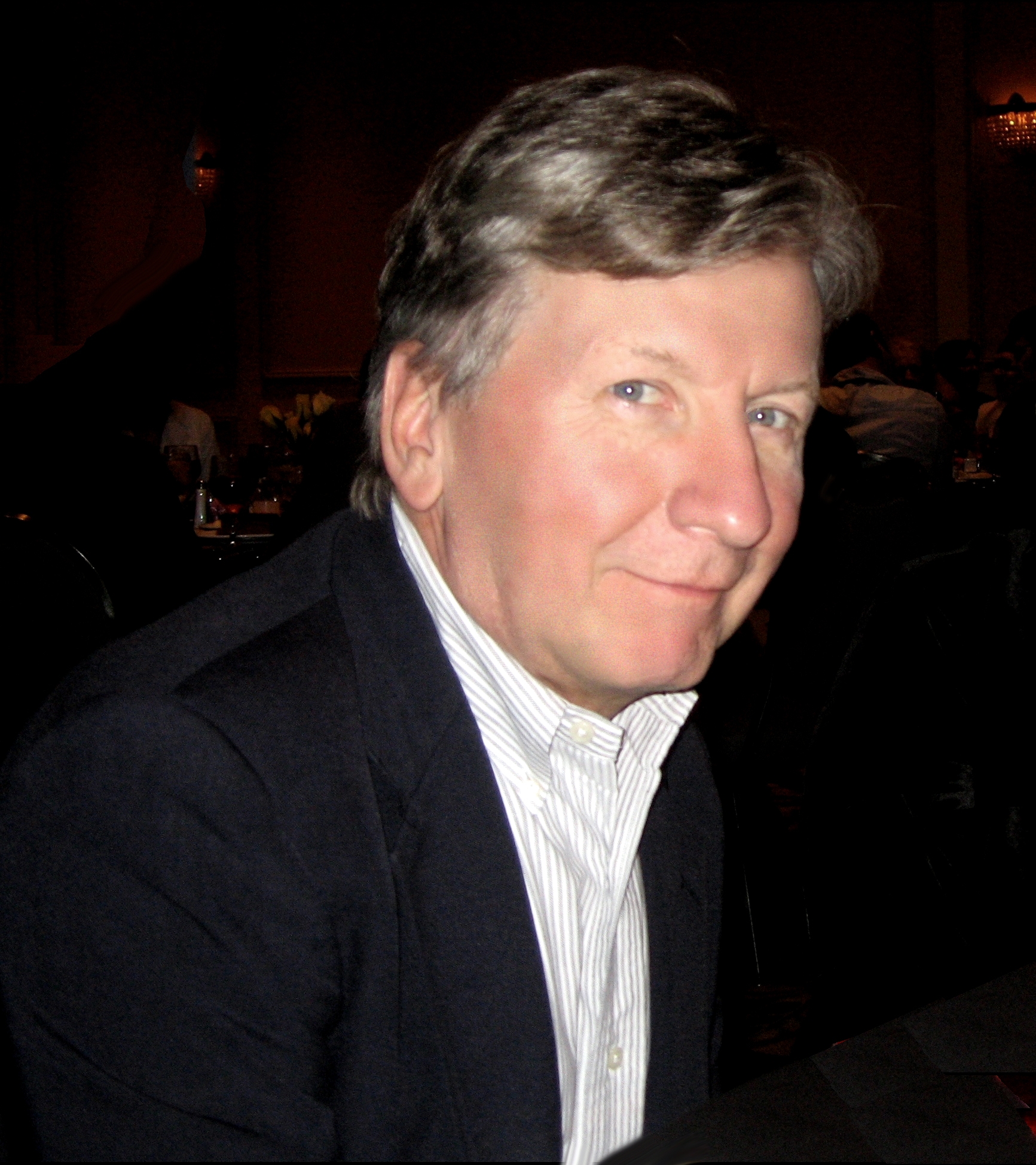
Ilya Somin will be the guest presenter and keynote speaker at the Libertarian Futurist Society’s 2026 Prometheus Awards ceremony.

A professor of Law at George Mason University and the B. Kenneth Simon Chair in Constitutional Studies at the Cato Institute, a leading libertarian think tank, Somin has written several books reflecting his research and expertise on constitutional law, property law, democratic theory, federalism, and migration rights.
Just as relevant to our upcoming August 2026 awards ceremony – which will be hosted on Zoom and open to the public – Somin is a long-time fan of science fiction and fantasy – which he plans to focus on in his speech presenting the Prometheus Hall of Fame for Best Classic Fiction.

This year’s five Hall of Fame finalists – first published between 1932 and 2003 – are novels by James Blish (The Star Dwellers), C.S. Lewis (That Hideous Strength), Aldous Huxley (Brave New World), Adam Roberts (Salt) and Charles Stross (Singularity Sky).
Among other topics in his presentation, “I will talk about what SF means to me,” Somin said in an email accepting our invitation for him to speak.
A TRADITION OF ELOQUENCE AND SUBSTANCE
For much of the past 47 years, Prometheus Awards ceremonies have been highlighted by fascinating, illuminating and often amusing speeches by former Prometheus winners and other prominent sf/fantasy authors.
Over the past half decade or so, when the Prometheus Awards have gone live via Zoom to the general public, the ceremony has been graced with such eloquent luminaries as F. Paul Wilson, a five-time Prometheus winner (An Enemy of the State), three-time Prometheus winner Victor Koman (Kings of the High Frontier), two-time Prometheus winner Travis Corcoran (The Powers of the Earth), and Best Novel winner Sarah Hoyt (Darkship Thieves), among others.
More recently, the LFS Board of Directors has broadened our range of awards-ceremony speakers beyond Prometheus winners and novelists to include a stimulating variety of leading libertarian thinkers and scholars – often discussing the connections between science fiction and the literature of liberty.

Among them: leading libertarian theorist and economist David D. Friedman (The Machinery of Freedom, Price Theory), author and Reason book editor Jesse Walker (The United States of Paranoia: A Conspiracy Theory, Rebels on the Air: An Alternative History of Radio in America), Reason editor-in-chief Katherine Mangu-Ward and Reason Foundation co-founder and former present-CEO Bob Poole, also a stalwart LFS supporter and member since the 1980s.

Friedman, who presented the Prometheus Hall of Fame last year at the mid-August Zoom ceremony, fit both categories of speakers as a Prometheus-nominated author of several fantasy novels (Harald, Salamander) and as one of the seminal law-and-economics anarcho-capitalist thinkers inspiring the further development of the libertarian movement of the 1970s and 1980s.
“It will be an honor to follow David Friedman, and others,” Somin said.
LIBERTARIANISM AND SCIENCE FICTION: THE CONNECTIONS
Friedman offered a fascinating and wide-ranging 2025 awards-ceremony speech about libertarian science fiction, his favorite libertarian sf/fantasy authors and how they influenced his own thinking. (To watch the video, visit the LFS website’s Video page, which offers descriptions and links of the 2025 awards ceremony and a dozen other past ceremonies and LFS panel discussions.)

Similarly, in his 2026 speech, Somin plans to discuss both libertarianism and science fiction, along with several of his favorite authors – including those previously recognized as winners or finalists in the Prometheus Awards.
Some idea of Somin’s approach can be gleaned from reading his excellent essay on “Libertarianism and Science Fiction,” published in 2011 in our Prometheus print quarterly. Among the themes Somin covered in his article, which he plans to update and amplify in his speech, are “Why the Politics of Science Fiction Matters,” “The Prevalence of Libertarian Ideas in the Genre,” and “Why Science Fiction is So Libertarian.”
“I tentatively plan to focus on those themes, but updated to take account of more recent developments,” Somin said.

SOMIN’S BOOKS, ARTICLES AND CONGRESSIONAL TESTIMONY
 Among Somin’s books: Free to Move: Foot Voting, Migration, and Political Freedom (Oxford University Press, revised and expanded edition, 2022), Democracy and Political Ignorance: Why Smaller Government is Smarter (Stanford University Press, revised and expanded second edition, 2016), and The Grasping Hand: Kelo v. City of New London and the Limits of Eminent Domain (University of Chicago Press, 2015, rev. paperback ed., 2016).

Somin also is coauthor of A Conspiracy Against Obamacare: The Volokh Conspiracy and the Health Care Case (Palgrave Macmillan, 2013), and co-editor of Eminent Domain: A Comparative Perspective (Cambridge University Press, 2017). Democracy and Political Ignorance, meanwhile, has been translated into Italian and Japanese.

According to his bio, Somin’s work has appeared in numerous scholarly journals, including the Yale Law Journal, Stanford Law Review, Northwestern University Law Review, Georgetown Law Journal, Critical Review, and others.
Somin has also published articles in a variety of popular press outlets, including the New York Times, Washington Post, Wall Street Journal, Los Angeles Times, CNN, NBC, The Atlantic, USA Today, Boston Globe, US News and World Report, South China Morning Post, National Law Journal and Reason.

He has been quoted or interviewed by the New York Times, Washington Post, Wall Street Journal, Time, Newsweek, The Economist, the Christian Science Monitor, the Financial Times, The Guardian, the Associated Press, CBS, MSNBC, NPR, BBC, Reuters, the Canadian Broadcasting Corporation, the Australian Broadcasting Corporation, Radio Free Europe/Radio Liberty, Al Jazeera, and the Voice of America, among other media.

Somin’s writings have been cited in decisions by the United States Supreme Court, multiple state supreme courts and lower federal courts, and the Supreme Court of Israel. He is co-counsel for the plaintiffs in VOS Selections, Inc. v. Trump, a case challenging the constitutionality of President Trump’s “Liberation Day” tariffs.
Somin has testified on the use of drones for targeted killing in the War on Terror before the US Senate Judiciary Subcommittee on the Constitution, Civil Rights, and Human Rights.
In 2009, he testified on property rights issues at the United States Senate Judiciary Committee confirmation hearings for Supreme Court Justice Sonia Sotomayor.
Somin writes regularly for the popular Volokh Conspiracy law and politics blog, now affiliated with Reason magazine (previously affiliated with the Washington Post from 2014 to 2017).
From 2006 to 2013, he served as Co-Editor of the Supreme Court Economic Review, one of the country’s top-rated law and economics journals.

SOMIN IS THE FIRST OF SEVERAL SPEAKERS TO BE CONFIRMED
Other speakers for the 2026 Prometheus Awards ceremony will be announced over the next several months. Emceed by LFS President William H. Stoddard, the annual ceremony typically is scheduled as an hour-long Zoom event on a Saturday afternoon in mid- to late August.
The date will be set once all the year’s winners are confirmed and contacted following the general membership’s voting leading up to the annual July 4 voting deadline.

ABOUT THE LFS AND THE PROMETHEUS AWARDS
* Join us! To help sustain the Prometheus Awards and support a cultural and literary strategy to appreciate and honor freedom-loving fiction, join the Libertarian Futurist Society, a non-profit all-volunteer international association of freedom-loving sf/fantasy fans.
Libertarian futurists understand that culture matters. We believe that literature and the arts can be vital in envisioning a freer and better future. In some ways, culture can be even more influential and powerful than politics in the long run, by imagining better visions of the future incorporating peace, prosperity, progress, tolerance, justice, positive social change, and mutual respect for each other’s rights, human dignity, individuality and peaceful choices.
* Prometheus winners: For a full list of Prometheus winners, finalists and nominees – including in the annual Best Novel and Best Classic Fiction (Hall of Fame) categories and occasional Special Awards – visit the enhanced Prometheus Awards page on the LFS website. This page includes convenient links to all published essay-reviews in our Appreciation series explaining why each of more than 100 past winners since 1979 fits the awards’ distinctive dual focus on both quality and liberty.
* Watch videos of past Prometheus Awards ceremonies, Libertarian Futurist Society panel discussions with noted sf authors and leading libertarian writers, and other LFS programs on the Prometheus Blog’s Video page.
* Read “The Libertarian History of Science Fiction,” an essay in the international magazine Quillette that favorably highlights the Prometheus Awards, the Libertarian Futurist Society and the significant element of libertarian sf/fantasy in the evolution of the modern genre.
* Check out the Libertarian Futurist Society’s Facebook page for comments, updates and links to the latest Prometheus Blog posts.
