
It’s always encouraging to see a Prometheus-recognized writer remembered in any contemporary article, especially about one of the hottest, most divisive and misunderstood issues of our day.

But it’s wonderful – and rare – to find two such authors remembered in the same article, especially one that quotes them with accuracy and insight.
The enduring wisdom of both C.S. Lewis and George Orwell is at the core of a sensible article about Artificial Intelligence by Benjamin M. Osborne in Chronicles magazine.
Orwell, of course, is a two-time Prometheus Hall of Fame inductee for his novels Nineteen Eighty-Four and Animal Farm. Lewis, meanwhile, is again a Hall of Fame finalist this year for his 1945 science fiction novel That Hideous Strength.
So what ideas and insights by Lewis and Orwell are explored and applied in Osborn’s June 2026 article, “What Would C.S. Lewis Have Thought of AI?”
THE USE AND MISUSE OF TECHNOLOGY

Quoting Lewis’ The Abolition of Man (which I consider his best and most libertarian-adjacent non-fiction book about political philosophy), Osborne observes that Lewis was clear-eyed about the potential misuse of technology for authoritarian ends.
“Machines are tools. Men have souls. When we forget the difference, we do not raise up the machine. We lower the man,” Osborn writes.
“Lewis saw this danger before AI, data centers, and servers. Modern man wants to conquer nature. But when man throws off moral law, “man’s conquest of Nature” soon becomes the rule of some men over other men. AI will not govern itself. Men will train it, tune it, censor it, sell it, and use it to govern other men.”
Osborn finds this troubling, as any rational and liberty-loving individual does.
“A tool trained by people who think speech is harm will teach others to fear plain speech. A tool trained by people who hate limits will teach others to hate limits. A tool trained by people who think man is only a bundle of wants will answer as if man were no more than that. No software is neutral when its makers are not,” he writes.
ORWELL’S COMMITMENT TO CLARITY

Osborn then weaves Orwell into his argument – quoting from one of the seminal essays of the 20th century.
“George Orwell helped us see what is coming. In “Politics and the English Language,” Orwell wrote that bad public speech is not just clumsy. It is dishonest. It piles up long words, stale phrases, and soft names until the facts disappear. The words do not defend the act; they rename it, doing what the Prophet Isaiah condemned: calling evil good and good evil, so the honest argument never has to happen.”
“Orwell called this inflated style a kind of euphemism. It falls on the facts like snow. It blurs the outline. It covers the blood. The great enemy of clear language, he said, is insincerity. When a man’s real aim differs from his declared aim, he reaches for cloudy words. He does not say what he means because he does not want others to see what he means.”

UTOPIAN HOPES AND DYSTOPIAN FEARS VS. REALITY
One of the chief virtues of Osborn’s article, just like Orwell and Lewis at their best, is that it helps us see reality more deeply and clearly.
In my view, that’s especially helpful at this point in time, when so many people are projecting their worst fears or utopian hopes on A.I.

History should remind us that previous generations repeatedly have projected their fears and hopes on earlier developments in technology. More often than not, what they imagined at its most extreme – for good or bad – never came to pass. Or if some aspects of what people hoped or feared did materialize to various degrees, it rarely materialized in the specific ways that most imagined.
Legitimate issues of individual liberty do arise as new technologies arise and spread, but that’s simply the perennial battle between Liberty and Power reappearing in new forms.
AI, Osborn cautions us, “can turn a lie into a memo, a threat into a policy, a command into a recommendation, and a sin into a service. It can help the coward sound kind and the tyrant sound calm. It can give every evasion a pleasant voice.
“We already live under this kind of speech. We are told to say ‘care’ when we mean killing, ‘safety’ when we mean censorship, ‘equity’ when we mean favoritism, ‘misinformation’ when we mean dissent, and ‘progress’ when we mean decay. AI did not invent this perversion of language. It only gives it a faster tongue.”
WAS LEWIS BOTH CHRISTIAN AND LIBERTARIAN?

Lewis, widely viewed as a leading Christian artist and moral philosopher of the 20th century, wasn’t a full-fledged modern libertarian (he couldn’t have been, since modern libertarianism didn’t fully develop until the 1960s-1980s).
Yet, the late libertarian science fiction novelist J. Neil Schulman, a two-time Prometheus winner for Alongside Night and The Rainbow Cadenza, hailed Lewis as the leading “Christian libertarian” of the 20 century – and ranked Lewis with Ayn Rand as the two greatest influences on his own thinking.
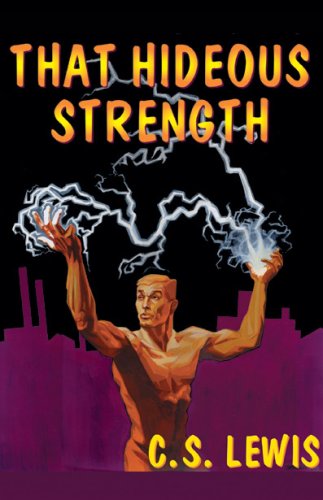 Even if Lewis wasn’t a consistent modern libertarian, was Schulman onto something? After all, both Lewis’ nonfiction book The Abolition of Man and his Space Trilogy, which culminates with That Hideous Strength, incorporate critiques of statism, authoritarian scientism and other authoritarian and illiberal trends of his era. The themes of both books are congruent with libertarianism, or at least are in several ways adjacent to it in fundamental focus and thrust.
That said, Osborne’s essay is written from a Christian perspective and frames Lewis’ wisdom and Orwell’s insights primarily in terms of ethics even more than politics.
“So the first Christian rule for AI is simple: Do not let the machine teach you to lie.” Osborn writes.
“Use it, perhaps, as one uses a calculator or a plow. But do not kneel to it. Do not ask it to replace your mind, your memory, your judgment, or your conscience. Do not let it write what you have not dared to think. Do not let it soften what ought to be said plainly.”
Such plain speaking and clear thinking is welcome in this or any era.

ABOUT THE LFS AND THE PROMETHEUS AWARDS
* Join us! To help sustain the Prometheus Awards and support a cultural and literary strategy to appreciate and honor freedom-loving fiction, join the Libertarian Futurist Society, a non-profit all-volunteer international association of freedom-loving sf/fantasy fans.
Libertarian futurists understand that culture matters. We believe that literature and the arts can be vital in envisioning a freer and better future. In some ways, culture can be even more influential and powerful than politics in the long run, by imagining better visions of the future incorporating peace, prosperity, progress, tolerance, justice, positive social change, and mutual respect for each other’s rights, human dignity, individuality and peaceful choices.
* Prometheus winners: For a full list of Prometheus winners, finalists and nominees – including in the annual Best Novel and Best Classic Fiction (Hall of Fame) categories and occasional Special Awards – visit the enhanced Prometheus Awards page on the LFS website. This page includes convenient links to all published essay-reviews in our Appreciation series explaining why each of the 106 works that have won a Prometheus since 1979 fits the awards’ distinctive dual focus on both quality and liberty.
* Watch videos of past Prometheus Awards ceremonies, Libertarian Futurist Society panel discussions with noted sf authors and leading libertarian writers, and other LFS programs on the Prometheus Blog’s Video page.
* Read “The Libertarian History of Science Fiction,” an essay in the international magazine Quillette that favorably highlights the Prometheus Awards, the Libertarian Futurist Society and the significant element of libertarian sf/fantasy in the evolution of the modern genre.
* Check out the Libertarian Futurist Society’s Facebook page for comments, updates and links to the latest Prometheus Blog posts.
