
The first human beings to journey into deep space since 1972 might be on their way as early as today.
The first flight of America’s ambitious Artemis mission aims to lift off in early March for the first crewed mission around the Moon since the Apollo era. Initially scheduled for February, Artemis 2 might take off on its next window in early April if the mission can’t make any of five potential launch dates March 6-9 or March 11.

“NASA does not expect to be able to land astronauts on the moon before 2027, at the earliest. Realistically, it’s unlikely that such an undertaking would occur before 2028. But the Artemis II mission is no perfunctory exercise. This will be a difficult and dangerous mission, and it’s a precursor to America’s eventual return to our nightly neighbor — this time, to stay,” columnist Noah Rothman wrote in an insightful National Review article about the prospects of the upcoming mission.

If all goes well, NASA’s Artemis II rocket will begin its 10-day mission, although final tests and checks, as well as a full fuel-up (a wet dress rehearsal) will be needed and may delay the launch later in February.
Whenever they finally embark upon the next step in humanity’s advance beyond planet Earth, let’s wish a hearty godspeed to the astronauts Victor Glover, Jeremy Hansen, Christina Koch and Reid Wiseman – and pray for their successful flight and safe return home.

HISTORY BEING MADE- AND REMEMBERED
The moon mission will carry a historic flag, initially set to fly on NASA’s Apollo 18 mission, which never occurred. That mission, along with Apollo 19 and Apollo 20, were canceled in 1970 due to shifting national priorities after the U.S. won the Cold War-era space race to the moon.
“The flag serves as a powerful emblem of America’s renewed commitment to human exploration of the moon, while honoring the legacy of the Apollo pioneers who first blazed the trail,” NASA officials said in a statement.

THOSE WHO DIDN’T LIVE TO SEE THIS DAY
If only visionary science fiction writers like Robert Heinlein, Poul Anderson, James P. Hogan, Jerry Pournelle, Ray Bradbury, A.E. Van Vogt, Jack Williamson, Vernor Vinge and Michael Flynn – all Prometheus winners – could have lived long enough to witness this latest step in our species’ progress.
I’m confident that they would have appreciated this hopeful return to space – perhaps with caveats.
Although libertarian science fiction fans and LFS members strongly support space exploration, development and industrialization advancing via the morally and practically superior path of private enterprise and free markets, the Artemis missions remains notable and hopeful as the first steps by human beings in more than half a century to physically venture beyond near-earth orbit.

Given recent tensions between the current American administration and Canada’s political leaders, it’s also nice to recognize that this flight will be an example of international cooperation. Jeremy Hansen, a Canadian astronaut, joins three American astronauts on this mission.
PROMETHEUS WINNERS RELEVANT TO TODAY’S PROGRESS IN SPACE
Such advances in space and science through voluntarism and cooperation of free societies and free markets are dramatized in quite a few works of science fiction – including quite a few Prometheus award-winners.
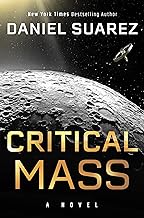 Perhaps the most relevant Prometheus Best Novel winners are Daniel Suarez’ Critical Mass, recognized by the Libertarian Futurist Society in 2024, and Victor Koman’s Kings of the High Frontier, recognized in 1997.
 Both novels are terrific, especially if read or reread right now. That’s because each work, in different but complementary ways, offers a convincing and detailed real-world vision of humanity’s expansion through and commercial industrialization of our solar system through free markets and individual initiative (itself always highly cooperative when pursued ethically without coercion or reliance on the inevitable force of State power.)
 Among other enjoyable and visionary novels more broadly imagining human advancement into the solar system, via a libertarian framework of non-aggression and voluntary exchange – including entire colonies and communities established on the moon or the asteroids – include such Prometheus winners as Robert Heinlein’s The Moon is a Harsh Mistress, Sarah Hoyt’s Darkship Thieves and Travis Corcoran’s The Powers of the Earth and its sequel Causes of Separation.
Science fiction doesn’t actually predict the future, of course – if the events of the 20th and 21st century prove anything, it’s that no one really can – but such works of fantastical fiction can point the way in some respects by expanding our imagination of what might be possible.
“Space exploration, in the sophisticates’ view, is a muscular waste of money — the fixation of bored billionaires, inertia-driven bureaucracies, and chauvinists who long for the bygone age of colonialist imperialism. But America’s return to space is no flight of fancy,” Rothman writes.
“Establishing a self-sustaining presence on the moon — one that could support the conversion of lunar ice into water, hydrogen, and oxygen for life support and fuel — is the first step on America’s journey into the solar system. Such a habitat would support ventures to Mars and, eventually, a permanent presence there. From the inner solar system, mankind can begin to explore and exploit the resources in the asteroid belt and, eventually, the outer solar system.
“All this sounds science-fictional and, therefore, foolish to some. And yet, given the resources they are dedicating to the pursuit of these far-off goals, every nation on earth with the requisite wealth and engineering capabilities disagrees. Becoming a spacefaring civilization is a stunning achievement with profound and measurably salutary psychological effects on that civilization’s allies as well as its adversaries. (In February), if conditions allow, we will get an awe-inspiring reminder of what an achievement it is to send humans to another world.”
Today, when science fiction has become scientific fact in so many areas of life and fields of study, and we’re once again on our way back to the moon and beyond, it’s a great time to be alive and re-imagine a more hopeful future of freedom, progress, prosperity, peace and universal human flourishing.

PIECES OF HISTORY
Symbolically, the Artemis II mission not only looks to the future but also honors the past by taking along several historical artifacts, in addition to the Apollo 18 flag.
According to an article on space.com, a piece of the Wright Brothers’ historic plane will fly on Artemis 2’s Orion spacecraft. From the brothers’ first-ever successful powered flight in 1993 over the dunes of Kitty Hawk, North Carolina, a 1-square-inch swatch of muslin fabric from the plane will circle the Moon. The piece is on loan from the Smithsonian’s National Air and Space Museum.
In addition, the rocket will carry an American flag that reached orbit on the first and final space shuttle missions, NASA announced on Jan. 21.
“Historical artifacts flying aboard Artemis 2 reflect the long arc of American exploration and the generations of innovators who made this moment possible,” NASA Administrator Jared Isaacman said in a statement.
“This mission will bring together pieces of our earliest achievements in aviation, defining moments from human spaceflight and symbols of where we’re headed next,” Isaacman said.
The mementoes placed on Orion will commemorate the historic nature of the mission, which takes place during the year of the United States’ 250th anniversary.

ABOUT THE LFS AND THE PROMETHEUS AWARDS
* Join us! To help sustain the Prometheus Awards and support a cultural and literary strategy to appreciate and honor freedom-loving fiction, join the Libertarian Futurist Society, a non-profit all-volunteer international association of freedom-loving sf/fantasy fans.
Libertarian futurists understand that culture matters. We believe that literature and the arts can be vital in envisioning a freer and better future. In some ways, culture can be even more influential and powerful than politics in the long run, by imagining better visions of the future incorporating peace, prosperity, progress, tolerance, justice, positive social change, and mutual respect for each other’s rights, human dignity, individuality and peaceful choices.
* Prometheus winners: For a full list of Prometheus winners, finalists and nominees – including in the annual Best Novel and Best Classic Fiction (Hall of Fame) categories and occasional Special Awards – visit the enhanced Prometheus Awards page on the LFS website. This page includes convenient links to all published essay-reviews in our Appreciation series explaining why each of more than 100 past winners since 1979 fits the awards’ distinctive dual focus on both quality and liberty.
* Watch videos of past Prometheus Awards ceremonies, Libertarian Futurist Society panel discussions with noted sf authors and leading libertarian writers, and other LFS programs on the Prometheus Blog’s Video page.
* Read “The Libertarian History of Science Fiction,” an essay in the international magazine Quillette that favorably highlights the Prometheus Awards, the Libertarian Futurist Society and the significant element of libertarian sf/fantasy in the evolution of the modern genre.
* Check out the Libertarian Futurist Society’s Facebook page for comments, updates and links to the latest Prometheus Blog posts.
