
 As part of the LFS’ ongoing Appreciation series of review-essays explaining how each Prometheus Award-winner fits the distinctive libertarian and anti-authoritarian focus of the sf/fantasy award and why it deserved to win, here is an Appreciation of Aldous Huxley’s novel Brave New World.
By Michael Grossberg
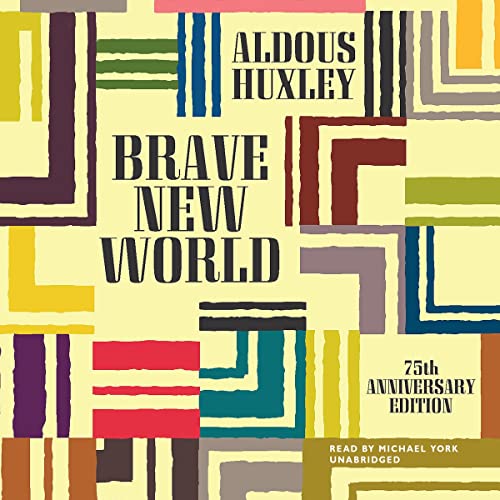
Brave New World, the 2026 Prometheus Hall of Fame winner, is a classic of dystopian literature. Yet, Aldous Huxley’s 1932 novel couldn’t be more timely as a cautionary tale about seemingly benevolent tyranny.
 Ranked fifth on Modern Library’s list of the century’s 100 Best Novels in English, Brave New World continues to connect with generations of readers, many anxious about losing individual identities and liberties in a fast-changing world dominated by authoritarian elites.
Responding to his era of rising absolutist ideologies, Huxley (1894-1963) achieved a remarkable clarity of vision. His novel explicitly dramatizes the inherent tensions between individualism and collectivism and exposes the consequences when the fertile and dynamic flux of freedom is replaced by the bland stasis of regimented conformity.
A CLASS-DEFINING ONE-WORLD STATE
Huxley’s dark future is even more disturbing because it seems perversely seductive.
In a future one-world state with a class-defined and tightly controlled economy, chemically bred babies are cloned and decanted, group-raised outside the family, assigned to rigid work roles and classes and medically and socially conditioned to be happy.
Archetypally, Huxley’s world government becomes the sly Serpent tempting humanity with a promised Garden of Eden where everyone is mindlessly happy – so long as we give up any prospect of tasting the Apple of knowledge and achieve adult self-awareness with its burdens of responsibility, individual choice and self-determination.
 Not all dystopian works fit the fantastical genres, but Brave New World is genuine science fiction – and one of the earliest SF works resonant enough to still be read.
Huxley’s world-building imagines new technologies reshaping how people work, live and play, such as personal copters that elite individuals fly like cars but take-off and land on the roofs of tall buildings.
Set in the year 2540 (632 AF or “After Ford” on the new calendar, which celebrates Henry Ford as a messianic figure), the World State diverts the docile population through escapist entertainments: electromagnetic golf, synthetic music and television (a mid-1920s invention but not yet a reality when Huxley wrote his novel in 1931).
 The State’s omnipresent motto: “Community, Identity, Stability.” Reinforcing that stability is a regimented economy modeled on Ford’s auto-assembly lines. (When Huxley was writing his novel in 1931, organizing industry and society along such corporate-socialist, fascist or communist lines was widely seen as the inevitable wave of the future.)
Most notoriously, Brave New World foresees new reproductive and child-rearing technologies, including artificial wombs, hints of genetic engineering, and more pervasive use of Pavlovian behavioral conditioning.
Some conditioning uses repetitive electrical shocks to force infants and children to associate pain with books, flowers and other attractive aspects of Nature, thereby developing an instinctive discomfort with them.
“They’ll be safe from books and botany all their lives,” the Director says smugly.
After all, “there was always the risk of their reading something which might undesirably recondition one of their reflexes.”
“There isn’t any need for a civilized man to bear anything that’s seriously unpleasant. And as for doing things – Ford forbid that he should get the idea into his head. It would upset the whole society if men started doing things on their own.”

AN ENFORCED HIERARCHY OF CASTES
Separate castes and are segregated into worker drones and administrative managers to fill predetermined roles in a politicized hierarchy. Privileged Alphas lead, with Betas, Gammas and Deltsa fill lower niches in the bureaucracy and lowly Epsilons, bred for limited intelligence, as menial laborers.
Love, marriage, parenthood and the family — the core of humanity — have been abolished, while the World State pushes mindless orgies, casual group sex and the brain-deadening pleasure drug “soma” to pacify the population.
Individual choice is suppressed, and individuality itself, denied.
“After all, what is an individual,” a representative of the ruling class asks.
With a sweeping gesture he indicated the rows of microscopes, the test-tubes, the incubators. “We can make a new one with the greatest ease – as many as we like. Unorthodoxy threatens more than the life of a mere; it strikes at Society itself. Yes, at Society itself,” he repeated.
Like many of the worst dictatorships, the World State employs psychological manipulation, propaganda, censorship, and the nearly complete suppression of history, classic literature and art to cement its authority. Anything that might raise doubts or spark independent thoughts is proscribed.

WARNING ABOUT A DEHUMANIZED FUTURE
Huxley explores the implications of several 1920s/1930s socio-political trends widely embraced by his Oxford University intellectual circle – most notably, the rise of progressivism and central planning to balance production and consumption.
Although Huxley doesn’t explicitly refer to communism as a model for his dystopian future, he names several characters suggestively – including Lenina Crowne, a popular and sexually desirable Beta hatchery worker, and Bernard Marx, a psychologist and accidentally-stunted misfit-Alpha who becomes the novel’s protagonist and anti-hero.

Naming such characters after Marx and Lenin invites obvious comparisons. Huxley’s vision of a pseudo-benevolent future dictatorship may be kinder, gentler and duller in its gray leveling than the mass-murdering extremes of forced famines, concentration camps and world wars under Marxist, Leninist, Stalinist and Hitler’s national-socialist regimes. Yet, Brave New World reveals similar rationalizations and the same justification of bad results with good intentions.
The tragic cost of such tyranny, Huxley feared, would be stasis and stagnation. What else could be the result when love, marriage, parenthood, individuality, rationality and curiosity are suppressed? How else can new generations mature and prosper when humanity’s heritage of art, literature, culture, history, science and independent thought have virtually disappeared?
SCIENCE, SCIENTISM AND THE MUZZLING OF HUMANITY
Huxley’s novel is a prime example of “social sf,” with Huxley portraying different customs, attitudes, social roles and relationships arising in future centuries. Perhaps most chilling, in this inhumane future, is the disparaging use of the words “father” and “mother” — not so much considered obscene as “merely gross, a scatological rather than a pornographic impropriety.”
As a Controller explains, the system is designed to constrain our very humanity:
“Each one of us, of course, goes through life inside a bottle… If we happen to be Alphas, our bottles, are, relatively speaking, enormous. We should suffer acutely if we were confined to a narrower space…”
Epsilons, at the other social extreme, are “foredoomed,” he said.
“Even after decanting, he’s still inside a bottle – an invisible bottle of infantile and embryonic fixations.”
The few rebels or nascent individualists become outcasts. A few wild islands or distant regions are left for them to survive on their own with “all the people who, for one reason or another, have got too self-consciously individual to fit into community life. All the people who aren’t satisfied with orthodoxy, who’ve got independent ideas of their own. Every one, in a word, who’s any one.”
Thus, truth and science become public dangers to stability, along with beauty, art, literature and history.
‘Science is dangerous; we have to keep it most carefully chained and muzzled,” the Controller explains to Helmholtz, an Alpha-Plus college engineering lecturer. Helmholtz, becoming restive writing propaganda amid the stifling conformism and philistinism of the World State, ultimately is exiled to the wild Falkland Islands.
Meanwhile, the World State’s eugenics-inspired program – incorporating cloning and chemicals to dumb down in their infancy those predetermined to fill the lower classes – is justified by reference to the society’s economics-as-regimentation ideology: “The principle of mass production at last applied to biology.”
 Ultimately, Huxley’s critique isn’t of science but scientism – the politicization and distortion of science to darker ends, sanctified and administered by a new priestly elite.
A ‘SAVAGE’ CHALLENGE TO THE ‘BRAVE NEW’ ORDER
Every collectivist assumption and practice of the World State is challenged by John the “Savage.”
Brought up by his exiled mother Linda in a primitive tribal society, John becomes a teenaged misfit in the wilderness, alienated from both worlds. Accidentally discovering and reading Shakespeare’s plays – one of only two books he’s read – John becomes a self-educated individual, and a proto-individualist dissatisfied with the status quo.
Once John and his ailing mother are brought from the wilderness to London, he recoils at this “brave new world.”
“But do you like being slaves?… Do you like being babies? Yes, babies. Mewling and puking,” John said.
“…Don’t you want to be free and men? Don’t you even understand what manhood and freedom are?”
Here Huxley deftly employs irony to highlight that John, named and disparaged as the Savage in London, actually embodies the culture and literacy of Shakespeare. He thus becomes a totemic symbol (albeit still immature) of our real-life civilization.
 The novel’s apt title, borrowed from Shakespeare’s play The Tempest (which itself uses the phrase ironically), is evocative on multiple levels.
Much of Shakespeare is woven into the novel, with John often quoting the Bard’s passages from several plays – sometimes, sadly, reflecting his limited outsider’s perspective and false assumptions about modern life, but often, reflecting his appreciation of the many human qualities that the Bard immortalized.
In this future when not only Shakespeare but virtually all of our civilization’s arts, culture and history have been suppressed, John’s defiant “savagery” becomes a poignant reminder of lost humanity.

THE PURSUIT OF “HAPPINESS” VS. SOCIAL CONDITIONING
The focus in this future is on “happiness” – but notably, not the pursuit of happiness enshrined in American culture, with its individualistic ethos. Rather, Brave New World vividly depicts a narcotized, constricted system of controls designed to ensure compliance, obedience and passivity.
As one upper-level administrator says proudly, ‘that is the secret of happiness and virtue – liking what you’ve got to do. All conditioning aims at that: making people like their inescapable social destiny.’
Ultimately, the Controller dismisses John’s desire for freedom as merely “the right to be unhappy.”
To his credit, John rejects the World State’s system:
“But I don’t want comfort,” he tells the Controller.
“I want God, I want poetry, I want real danger, I want freedom, I want goodness. I want sin…. All right then, I’m claiming the right to be unhappy,” John says defiantly.
“Not to mention the right to grow old and ugly and impotent… the right to be lousy, the right to live in constant apprehension of what may happen tomorrow…”
There was a long silence.
“I claim them all,” said the Savage at last.
HOW A SATIRE BECAME MORE SERIOUS

A writer known for satires, Huxley initially conceived his novel as a parody of collectivist blueprints for the future, especially H.G. Wells’ 1905 novel A Modern Utopia. However, as Huxley explained in a letter to an American friend, he had “been having a little fun pulling the leg of H. G. Wells” but then “got caught up in the excitement of [his] own ideas.”
As an encyclopedia biography of Huxley observes, “Unlike the most popular optimistic utopian novels of the time, Huxley sought to provide a frightening vision of the future.”
Despite one common misconception, Brave New World is not so much cautioning readers about genetic engineering, biotechnologies or other futuristic technologies but is actually exploring a far more worrisome possibility: how the totalitarian impulse threatens the core values and prerequisites of civilization itself.
 Intriguingly, this aspect of Brave New World was recognized by the Austrian-school economist and classical liberal Ludwig Von Mises (himself hailed by Friedrich Hayek, Ayn Rand, and Murray Rothbard as among the greatest libertarian thinkers). According to an encyclopedia entry about Huxley’s novel, Mises wrote in 1944: “Aldous Huxley was even courageous enough to make socialism’s dreamed paradise the target of his sardonic irony.”
HUXLEY’S LEGACY
To Huxley’s immense credit, he foresaw that any kind of authoritarian command-and-control system inevitably undermines liberty, literacy and all the other civilized values he cherished.
Huxley lived long enough to observe that his vision of “soft tyranny” were more likely to materialize more widely than the hard tyranny depicted by his former student and friend Eric Blair (George Orwell) in Nineteen Eighty-Four.
 In Brave New World Revisited, a 1959 nonfiction sequel to his bestseller, Huxley delineated how the world was moving toward his dark vision faster than he’d imagined.
Although much of our 21st-century world is freer and better off in many ways than in most past generations, some disturbing developments have reinforced Huxley’s warning since his passing.
Perhaps most ominously, China’s increasingly influential social-credit system uses blacklists, databases, financial-credit mechanisms and administrative enforcement to reward and punish individual behavior and prevent dissent.

Even if Western countries resist growing efforts by political elites worldwide to adopt China’s social-credit systems as a useful model to maintain control, the tendencies separately and newly unleashed toward conformity, cancellation, regimentation, mob rule and moral panics by social media remain worrisome for the future of freedom.
In retrospect, Huxley may have been more prescient than he or anyone realized.
Today, Brave New World remains a potent reminder of how our liberties and our very humanity can be lost, even or especially when the brutal fist of coercive government is masked by a velvet glove.

ABOUT THE PROMETHEUS AWARDS
* Join us! To help sustain the Prometheus Awards, honor outstanding freedom-loving fantastical fiction and find fellowship with other fans, join the Libertarian Futurist Society, a non-profit all-volunteer international association of freedom-loving sf/fantasy fans.
Libertarian futurists understand that culture matters. We believe that literature and the arts can be vital in envisioning a freer and better future. In some ways, culture can be even more influential and powerful than politics in the long run, by imagining better visions of the future incorporating peace, prosperity, progress, tolerance, justice, positive social change, and mutual respect for each other’s rights, dignity, individuality and peaceful choices.
* Prometheus winners: For a full list of Prometheus winners, finalists and nominees – including in the annual Best Novel and Best Classic Fiction (Hall of Fame) categories and occasional Special Awards – visit the enhanced Prometheus Awards page on the LFS website. This page includes links to all published essay-reviews in our Appreciation series explaining why each work that has won a Prometheus since 1979 fits the awards’ distinctive dual focus on both liberty and literary quality.
* Watch videos of past Prometheus Awards ceremonies, Libertarian Futurist Society panel discussions with noted sf authors and leading libertarian writers, and other LFS programs on the Prometheus Blog’s Video page.
* Read “The Libertarian History of Science Fiction,” an essay in the international magazine Quillette that highlights the Prometheus Awards, the Libertarian Futurist Society and the significant element of libertarian sf/fantasy in the evolution of the modern genre.
* Check out the Libertarian Futurist Society’s Facebook page for comments, updates and links to Prometheus Blog posts.
